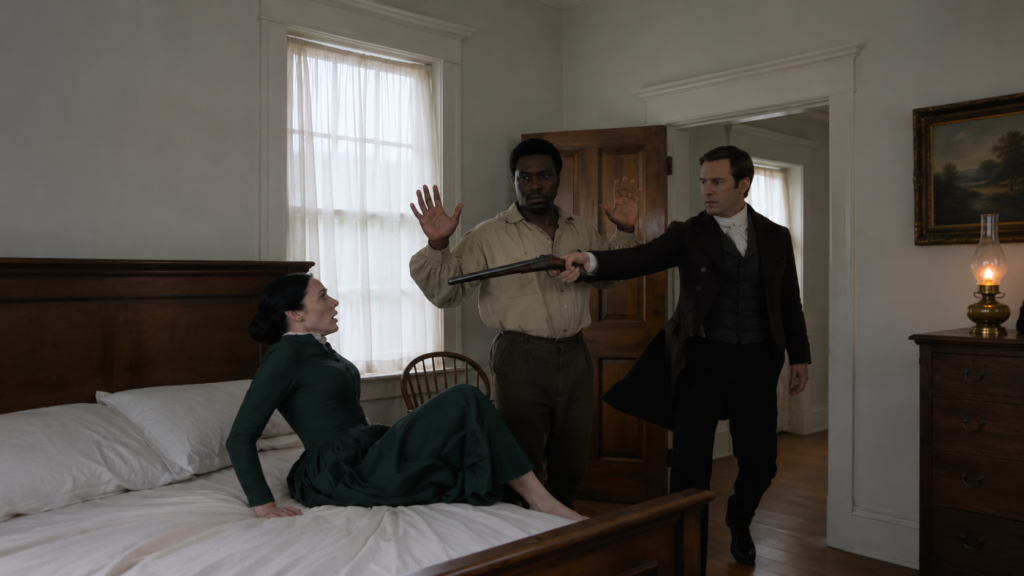
The pistol remained pointed at Isaiah Cole even after Richard Whitmore lowered his wrist.
Rain tapped against the bedroom windows, and the sound seemed absurdly gentle beside the danger in the room.
Eleanor sat on the edge of her bed with one hand pressed against her swollen ankle.
Her face had lost its color, but Isaiah noticed that her eyes remained fixed on the weapon.
Richard looked at his wife as though she had spoken in a language he had forgotten.
“My brother has been dead for six years,” he said.
Eleanor swallowed.
“You never found his body.”
Richard took a step toward her.
“You told me he drowned crossing the river.”
“I told you what your father ordered me to tell you.”
Isaiah knew that a single careless movement could end his life.
He kept both hands visible and measured the distance between the bedroom door and the narrow passage beyond it.
Richard saw the movement and swung the pistol toward him again.
“Stay where you are.”
Isaiah stopped.
Eleanor gripped the bedpost.
“He did not touch me, Richard.”
“Then why did you bring him into our bedroom?”
“My ankle gave way on the stairs.”
“Why did you say he knows about Thomas?”
Eleanor closed her eyes.
“Because I saw him at the mill that night.”
Richard turned slowly toward Isaiah.
“Is that true?”
Isaiah thought of the wooden bridge beyond the mill, the lantern swinging above black water, and the voice that had called his name from the dark.
He remembered Thomas Whitmore as a young man with a battered leather satchel and an impossible belief that a signature could undo a lifetime of cruelty.
He also remembered the sound of a gunshot.
“I was there,” Isaiah said.
Richard’s expression hardened.
“Why have you never told me?”
“Because your father had my mother locked in the smokehouse the next morning.”
The room fell silent.
Richard had been away in Charleston when his brother disappeared.
He had returned to a grieving household, a closed coffin, and a story repeated so often that it eventually became the only story anyone dared to tell.
He had never asked why the coffin remained closed.
He had never asked why his father sold three workers from the mill before the burial.
He had never asked why Eleanor refused to enter the chapel during the service.
Now the questions stood around him like witnesses.
“What happened to Thomas?” Richard asked.
Isaiah looked at Eleanor.
She was shaking, but her expression carried something more complicated than fear.











