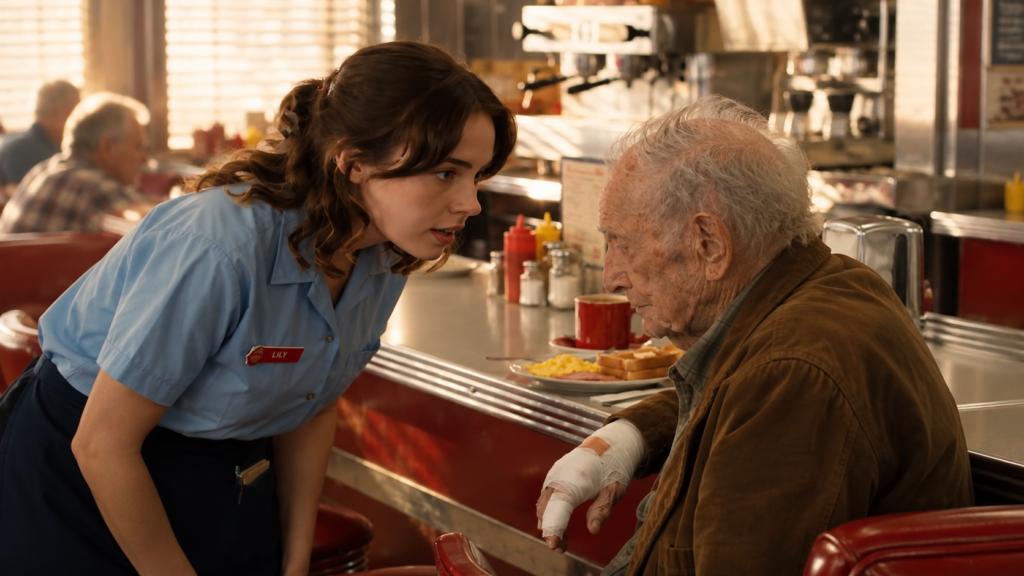
The first thing Lily Hart noticed about the old man was not the bandage. It was the way he stood outside the diner and watched the door as though entering required a decision he had been rehearsing for years.
The second thing was the bandage, white gauze wrapped around his left hand, with a thumb poking out at an uncomfortable angle. He came in during the lull between breakfast rushes, when the Maple Turn Diner smelled of burned toast and fresh coffee and every table had at least one sticky patch the cleaning cloth had missed.
Lily was twenty-five, with a rent increase folded into her apron pocket and a pair of shoes she had repaired twice with glue. She was collecting dishes when he chose the booth closest to the window.
“Morning,” she said. “Coffee?”
“Please. And eggs, over easy. Toast. The potatoes, if they’re good.”
“They’re good when Mateo makes them. He’s cooking today.”
He smiled at that, though it was an expression that seemed to cost him something. His name, she learned from the ticket, was Walter. He did not offer a surname.
When Lily returned with breakfast, Walter looked down at the plate and stayed perfectly still. Five minutes later the toast remained untouched. His coffee had cooled. He had moved the fork from one side of the plate to the other, but had not managed a bite.
“Are you feeling sick?” Lily asked quietly.
He shook his head. “I can’t hold the fork steady.”
He tried to demonstrate, perhaps to make the problem seem smaller than it was. The fork tilted, struck the plate, and bounced onto the table. Walter looked away toward the traffic outside.
Lily had spent enough time watching people pretend they were fine to recognize that particular silence. She did not pick up the fork for him. She asked, “Would it help if I made this easier to manage?”
He considered the question, then nodded once.
She carried the plate to the counter, cut the eggs and toast into manageable pieces, and moved the potatoes into a shallow bowl. She exchanged the heavy ceramic mug for a light paper cup with a sleeve. Then she brought everything back without announcing to the room what she had done.
“Try that,” she said.
Walter picked up a spoon with his good hand. The first bite was awkward. The second was easier. He gave her a grateful, almost surprised look.
From the service station, manager Colin Pruitt frowned. “Lily, tables six and nine need clearing. You’re wasting time.”
“I’ll get them,” she answered.
She did, then returned when Walter needed another napkin. She remained close enough to help without hovering. He finished almost all the potatoes, drank the coffee, and asked her name twice. The second time he said it slowly, as if committing it to memory.











