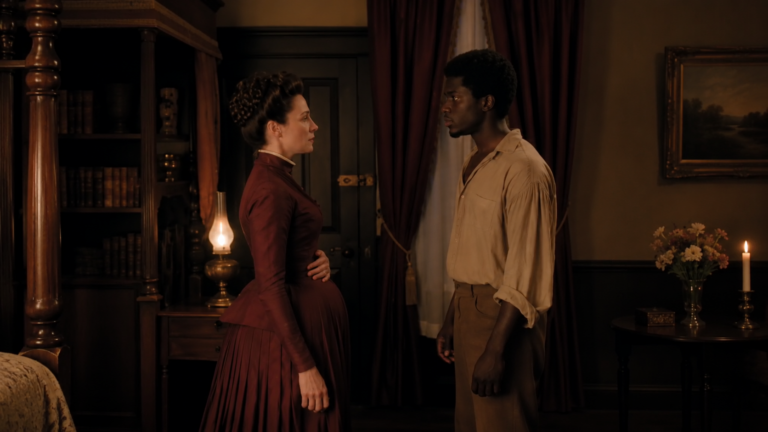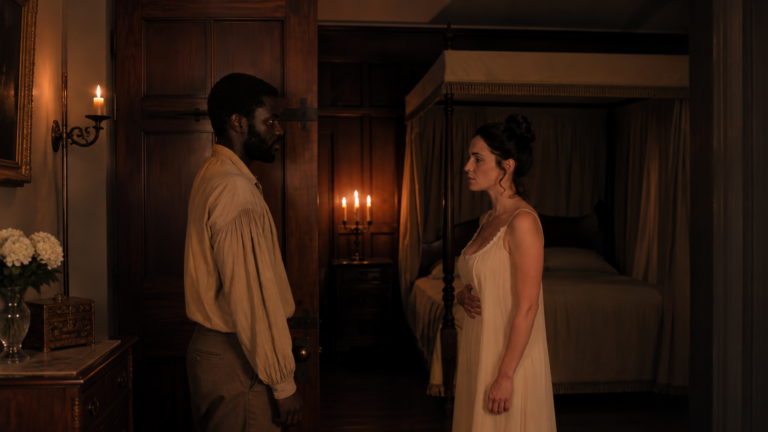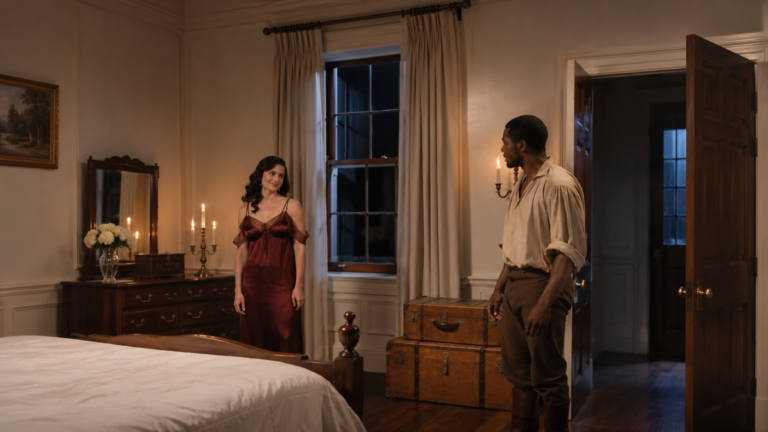
Daniel Carter was repairing a cabinet in the plantation woodshop when Lady Catherine entered after midnight and closed the door behind her.
He knew it was after midnight because the kitchen clock had struck twelve while he fitted the second hinge. The plantation slept in fragments: the great house behind drawn curtains, the cabins along the orchard road, the watchman crossing the mill yard with a lantern. His shop smelled of linseed oil and shaved walnut. A brass pin rolled between his fingertips as Catherine approached the bench.
“You know why I came,” she said.
Daniel set the pin in its tray. She wore a blue dressing gown beneath a black cloak, inappropriate clothing for the cold workshop and, worse, clothing intended to be noticed. She had come three times that month, never with a request he could carry out and leave behind. The first time she had asked about a warped drawer. The second, a lock that had not been broken. The third, she had stood beside him while he worked and spoken about loneliness as if loneliness excused a person for frightening someone who could not safely refuse her.
“I do not belong to you that way,” he said.
For a moment, she looked startled, as though the words were a language she had not expected him to speak.
“You have a fine opinion of yourself.”
“I have work to finish.”
She touched the half-built cabinet. “My husband thinks you are indispensable.”
“Your husband has never asked whether I agree.”
The air changed. Catherine withdrew her hand. Daniel understood that she had expected either gratitude or fear, and his steady voice had supplied neither.
“If you embarrass me,” she whispered, “I can have you sold before breakfast.”
He had been sold once, as a boy, and knew the sound of an auctioneer discovering that a human being had an injured knee. He knew how family names vanished across a yard once somebody with money raised a hand. He felt fear now, sharply, but refused to give it the shape of a plea.
Daniel opened the door and stood aside. “Good night, ma’am.”
Catherine passed him. The hem of her gown brushed a pile of curled shavings. She paused just outside, looking toward the house where two upper windows glowed. For an instant he thought she meant to say something different. Instead she went away through the damp grass.
Daniel secured the cabinet with a clamp and turned down his lamp. He would later remember that he had left the left-hand drawer open by a finger’s width so its finish could dry. He would also remember that the latch of the outer door had never clicked after Catherine crossed the yard. The wind could have nudged it closed. Somebody else could have entered.