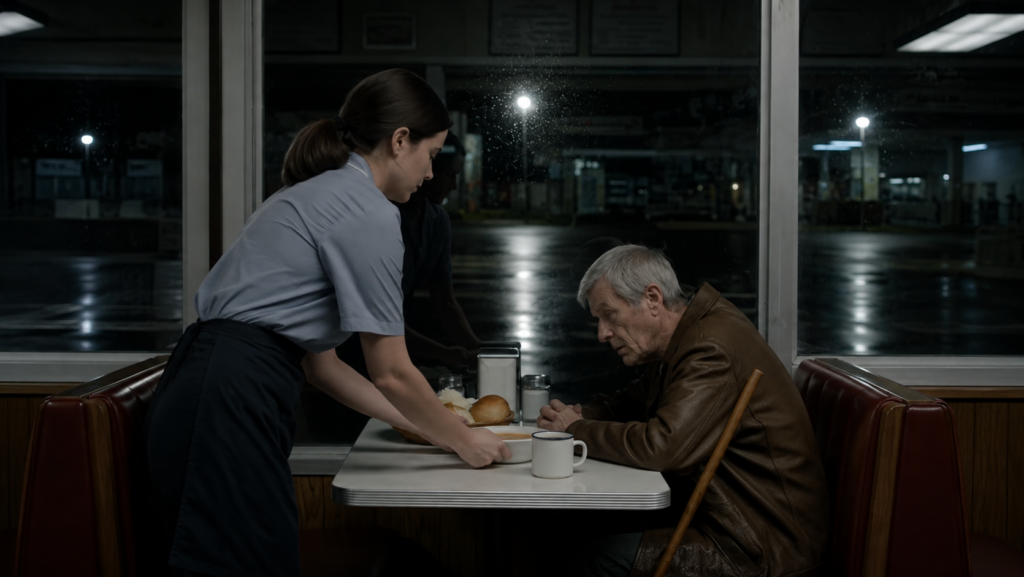
The man with the briefcase waited until Grant Hale stopped smiling.
Emily Carter stood beside the cash register with her final paycheck still folded in her hand.
Outside, twelve black SUVs filled the wet parking lot like a row of silent barricades.
The elderly man she had fed the previous night stood beneath a black umbrella, watching through the glass.
Grant looked at the suited visitor and attempted a laugh.
“I think there’s been some misunderstanding,” he said.
“My question was straightforward,” the visitor replied.
“Which one of you fired her?”
Grant glanced at Emily as though she had arranged the entire spectacle.
“I made a staffing decision,” he said.
“Then you are the person I need,” the visitor answered.
He opened the briefcase and removed a laminated photograph of the diner.
Emily recognized the building immediately, but the picture showed the rear service lane instead of the front entrance.
A yellow school bus stood beside the dumpster in the photograph.
There was no school bus in the lane now.
“Where was this taken?” Emily asked.
“At five forty this morning,” the man replied.
Grant reached for the photograph.
The visitor drew it back before his fingers touched the plastic.
“My name is Adrian Vale,” he said.
“I coordinate an independent evacuation service for the twelve families whose vehicles are outside.”
Emily looked through the window again.
She had assumed the men in dark coats were bodyguards.
Now she noticed women and children sitting behind several tinted windows.
A girl pressed her palm against the glass of the fourth vehicle.
The old man came inside with his cane and stopped at Emily’s side.
“I am Samuel Rook,” he told her.
“I owe you an apology for returning like this.”
“You don’t owe me anything,” Emily said.
“I owe you the truth,” Samuel replied.
Grant folded his arms.
“I don’t allow private meetings on company property,” he said.
Samuel turned toward him.
“You allowed a private contractor to use your back lot before dawn,” he said.
Grant’s face changed.
Emily saw it happen in the same instant that Adrian closed the briefcase.
“I didn’t know there were people inside that bus,” Grant whispered.
Samuel gripped his cane with both hands.
“Then we have less time than I hoped,” he said.
Chapter Two: The Road Behind the Diner
Emily had worked at the diner for eleven months without once seeing a school bus in the service lane.
The lane led to an abandoned weigh station and a county road that disappeared into the hills.
Grant had always told employees to keep the rear door locked after midnight.
He claimed that delivery trucks sometimes mistook the diner for the nearby fuel depot.
Now he moved toward that same door with a speed Emily had never seen from him.
Adrian stepped between Grant and the handle.
“You can explain the bus from here,” he said.
Grant stopped.
“A driver asked to park for twenty minutes,” he answered.
“He said the passengers were going to another shelter.”
“What shelter?” Samuel asked.
Grant stared at the floor.
“He didn’t tell me.”
Emily remembered the old man’s hands trembling over his soup the previous night.
She remembered the way he had looked toward the rear hallway every time the freezer motor started.
“You were waiting for that bus,” she said.
Samuel nodded.
“I was trying to learn whether it would stop here.”
“Why didn’t you tell me?”
“Because I had no right to pull you into a dangerous matter without your consent.”
Grant let out a bitter laugh.
“That’s convenient,” he said.
“You came here pretending to be broke, and now you arrive with a convoy.”
Samuel looked directly at him.
“I was broke when I walked in,” he said.
“My wallet was stolen at the station, and I had spent the day walking because my phone was dead.”
“Then whose cars are those?” Grant demanded.
“They belong to families who refused to leave their neighbors behind,” Samuel replied.
A woman entered from the parking lot, carrying a boy whose shoes were tied together by their laces.
“Samuel, the northern road is blocked again,” she said.
“The barricades went up while we were waiting.”
The boy looked at Emily and asked whether the diner had hot chocolate.
Emily reached instinctively for a mug.
Grant caught her wrist.
“You don’t work here anymore,” he said.
Emily pulled away.
“Then I can give him my own drink,” she answered.
She took the mug from the shelf and filled it at the dispenser.
The woman watched Emily with a tired, suspicious expression.
“Who is she?” she asked Samuel.
“The person who fed me when I couldn’t pay,” Samuel replied.
“And the person this manager dismissed for doing it.”
The woman looked toward Grant.
“We don’t have room for another argument,” she said.
“We need a road that is still open.”











