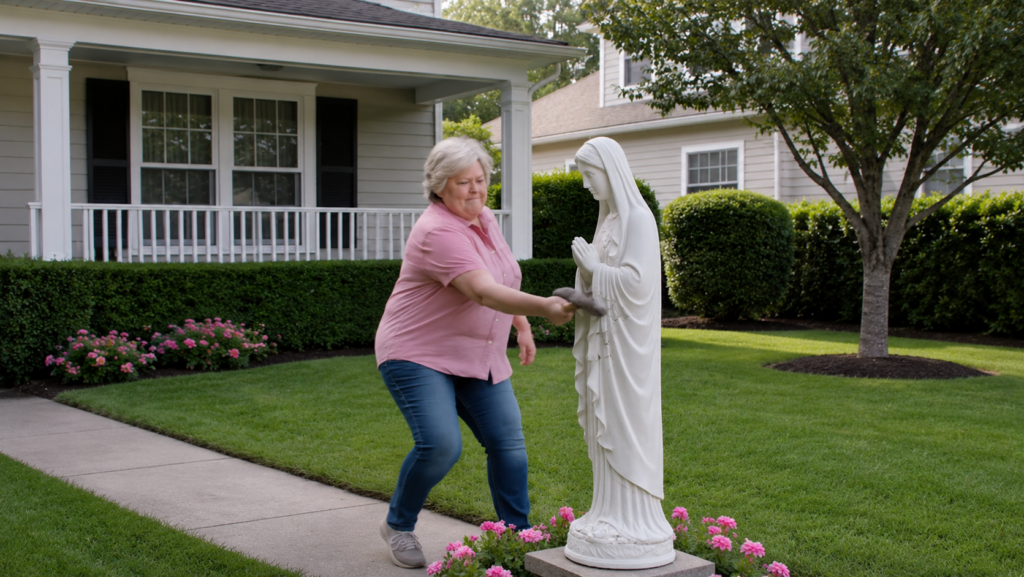
The first strike sounded like a car crash against the quiet Sunday morning.
I was standing at my kitchen sink when the noise came through the open window.
My coffee cup slipped from my hand and struck the counter.
Across the street, a woman in a faded blue raincoat stood beside the marble statue in my front yard.
She raised an axe with both hands and brought it down again.
A white fragment flew across the grass and bounced against my driveway.
I recognized the woman as Lorraine Mercer, the retired school secretary who lived three doors down.
She had never spoken more than twenty words to me in the four months since I bought the house.
Now she was destroying a statue that had stood there longer than either of us had lived on Hawthorne Lane.
I ran outside without my shoes.
“Put that down,” I shouted.
Lorraine swung again, and a deep crack opened across the stone man’s chest.
The head tilted toward the hydrangeas.
“You don’t understand,” she said.
“You can explain it to the police,” I told her.
She looked at my front door instead of my face.
“Is the boy inside?” she asked.
The question stopped me where I stood.
My son, Oliver, was spending the weekend with his mother in the next town.
I had never told Lorraine that I had a son.
“What boy?” I demanded.
Lorraine’s face changed as though she had expected a different answer.
She lowered the axe.
Then she knelt beside the broken base and began feeling beneath a loosened square of marble.
I reached for her arm, but she pulled away.
“Please,” she said, “just let me see whether it’s still there.”
A second neighbor appeared on his porch with his phone raised.
By the time the first police cruiser turned onto our street, Lorraine had lifted a thin metal box from beneath the shattered statue.
She held it against her chest like something alive.
And when she saw the officers, she did not run.
She said she had been waiting for them for seventeen years.
Chapter 2 — THE HOUSE ON HAWTHORNE LANE
My name is Nathan Cole, and I had moved to Hawthorne Lane because I wanted a quiet place to start again.
I was thirty-nine years old, recently divorced, and the kind of father who measured good weeks by how many ordinary dinners he shared with his son.
The house was a modest brick colonial on the edge of an Ohio town called Bellweather.











