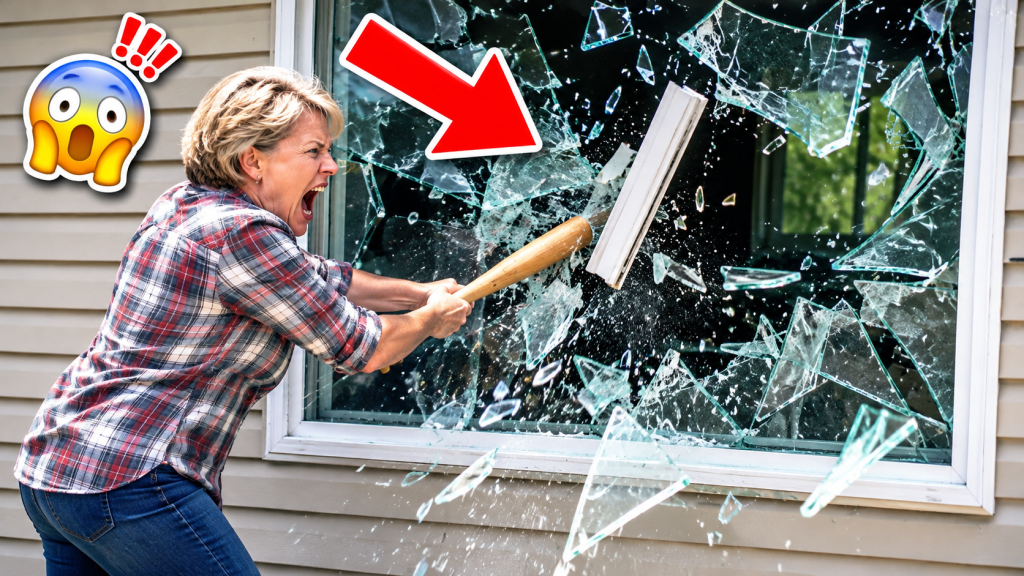
The first piece of glass landed in my daughter’s cereal bowl at seven minutes past six on a Tuesday morning.
The second piece struck the kitchen floor hard enough to make our old dog leap from his bed.
By the time I reached the back door, the woman next door was standing in my flower bed with a short iron garden stake in her hand.
Her name was Celeste Harrow, and she had lived beside us for exactly eleven weeks.
She wore a cream-colored raincoat despite the clear sky, and her expensive shoes were planted in the soil where my wife had once grown marigolds.
My daughter, June, stood behind me with a spoon in her hand and milk on her pajama sleeve.
Celeste looked directly at the broken kitchen window and smiled as though she had just corrected a crooked picture frame.
“You were warned,” she said.
I asked her what she thought she was doing.
“Enforcing the reflection rule,” she answered.
I had lived on Bellweather Lane for fourteen years, and I had never heard of a reflection rule.
Celeste pointed at the glass still clinging to the frame.
“No residential window may reflect directly into a neighboring owner’s private garden before eight in the morning,” she declared.
I looked at the ordinary kitchen window that had been there since the house was built in 1986.
It faced east, just as it had faced east for nearly forty years.
The morning sun was rising over the trees behind Celeste’s property, and the broken pane was no more reflective than the wet windshield of her silver SUV.
“That isn’t a rule,” I told her.
She raised the garden stake again.
“It is now,” she said.
I moved between her and the remaining glass.
June made a small sound behind me, and I heard the dog scratching at the kitchen tile.
I asked Celeste to put the stake down and leave my property.
She reached into her coat pocket and produced a folded sheet of paper.
The heading read NEIGHBORHOOD VISUAL PRIVACY ADDENDUM in heavy black letters.
Below the heading was a paragraph about reflected light, quiet enjoyment, and immediate abatement.
There was no signature from a town official, no recording number, and no reference to any association that governed our street.
The last sentence was underlined in red.
It claimed that an affected neighbor could remove a violating reflective surface without waiting for the property owner’s consent.
“You made this up,” I said.
Celeste tilted her head.
“You should have read what came with your deed,” she replied.
I took out my phone and photographed the paper while she held it.
Her smile thinned when she realized what I was doing.
“You aren’t allowed to record me in my own privacy zone,” she said.











