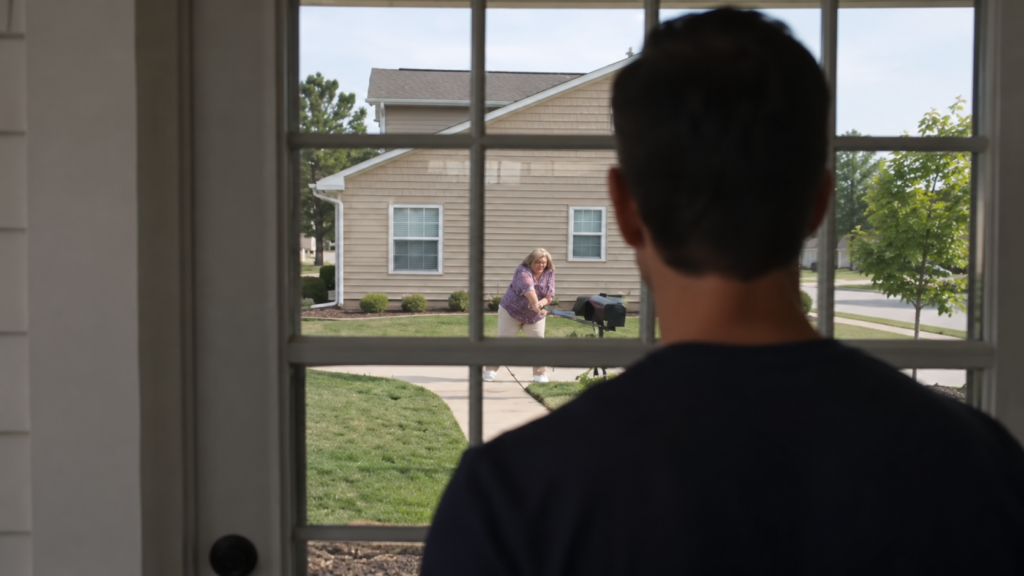
The first time Marjorie Kessler threatened me, she was holding a grocery bag full of unopened mail that did not belong to her.
It was Tuesday morning in the small Pennsylvania town of Briar Glen, and I was standing barefoot on my porch with a mug of coffee cooling in my hand.
She wore a green cardigan despite the heat, and her silver hair was pinned so tightly that her face looked permanently surprised.
Her other hand rested against the brass handle of my front door as though she had already decided she was welcome inside.
I had lived next door to Marjorie for seven months, long enough to know that she hated unfamiliar cars, children on bicycles, and any trash bin visible before six in the evening.
Until that morning, I had thought she was merely lonely and unpleasant.
She looked past me into my hallway and asked whether the mail had arrived.
I told her the carrier usually came around eleven.
She stepped closer and lowered her voice.
“If a cream envelope comes here with a blue lighthouse on the corner, you give it to me without opening it.”
I asked why a letter addressed to my house would belong to her.
“Because some things were settled before you bought this place,” she answered.
The grocery bag rustled as she tightened her grip.
Through the opening, I noticed an electric bill addressed to a man two streets away.
I asked why she was carrying other people’s envelopes.
She smiled for the first time, and the expression made me wish she had stayed angry.
“I help the carrier when the neighborhood gets confusing.”
I knew the letter carrier, Andre Salinas, and I knew he did not ask private citizens to deliver his route.
I told Marjorie I would return any misdelivered mail to the postal service.
Her smile vanished.
“You have a daughter, don’t you, Leah?”
My daughter, Sophie, was twelve and had just started walking to the middle school with two friends.
Marjorie had watched them leave less than ten minutes earlier.
I set down my coffee and told her to leave my porch.
She glanced at the camera mounted above the door, then back at me.
“People who make trouble around here tend to regret it.”
I shut the door before she could say anything else.
My hands shook so badly that coffee spilled across the entryway table.
I had moved to Briar Glen after my husband’s death because I wanted Sophie to have quiet streets, a small garden, and a chance to grow up without another crisis.











