The fence was already standing when Rachel Miller came downstairs on Tuesday morning, although she had gone to bed looking out at an uninterrupted strip of grass.
Its fresh cedar boards crossed the yard at an angle that made the place seem subtly unfamiliar.
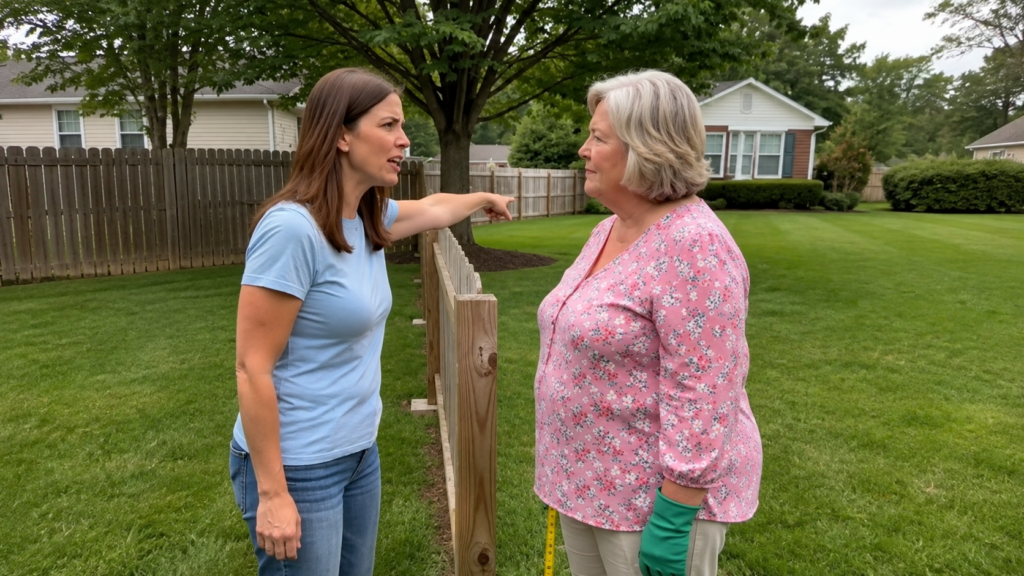
Beyond them stood Carol Benson, sixty-two, wearing yellow gardening gloves and holding a tape measure against one of the new posts.
For three years, Rachel had watched Carol tend her roses through the old chain-link divider, sometimes offering a wave and receiving a stiff nod.
That morning Carol behaved as if Rachel were a stranger who had wandered into the wrong backyard.
Rachel stepped off her porch without finishing her coffee.
“Why is that fence on my land?” she asked.
Carol did not look surprised.
“It’s always been mine,” she answered.
Rachel could still see the rectangular pale patches where the old chain-link posts had been pulled out.
A wheelbarrow of fresh soil stood beside a newly poured footing.
“No, it hasn’t,” Rachel said.
“That fence used to run along the hedge.”
Carol folded the measuring tape with a loud snap.
“Prove it.”
Rachel wanted to shout.
She wanted to grab one of the boards and shake it until Carol finally looked at her.
Instead she glanced at the little red swing hanging from the maple tree, the one her daughter Lucy had installed during the first summer in the house.
The new fence took away the narrow side of the yard where Lucy had once practiced throwing a softball.
Rachel had no intention of allowing somebody to claim those memories by moving a wooden wall.
“Who installed it?”
Rachel asked.
“A professional crew,” Carol said.
“They had the measurements.”
Rachel noticed that Carol offered neither a company name nor a permit.
“The measurements of what?”
Carol gave a tight smile.
“The property line, naturally.”
Rachel lifted her phone and photographed the post, the old holes, the fence’s crooked angle, and the broken branches under the grass.
She took pictures of Carol standing on the disputed strip without raising the camera into the woman’s face.
Carol muttered that taking photographs was harassment.
Rachel replied that photographs were cheaper than arguing.
Inside, Rachel opened the folder she had kept since buying the house.
It contained the closing statement, a mortgage discharge from the previous owner, and a property sketch with measurements too blurry to settle anything.
Her late mother had taught her to keep records, not because people were always dishonest, but because memory had a way of becoming convenient whenever money entered a disagreement.