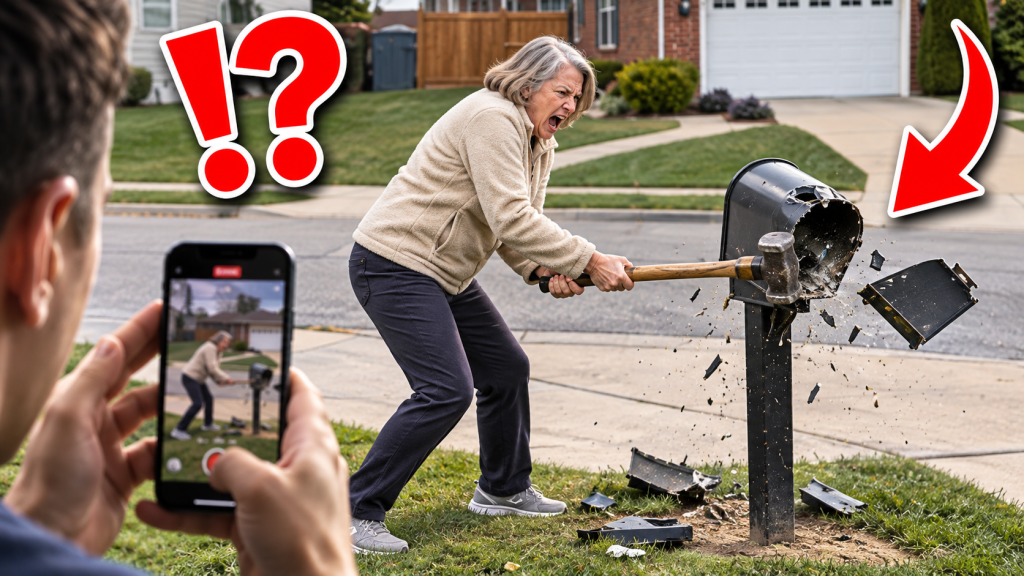
The morning I found my mailbox split open, a strip of pale blue paper was caught beneath the broken hinge.
It was the only piece of mail my neighbor had failed to take.
I knew that because every other envelope had disappeared, including a letter I had been waiting for since my mother died.
Across the street, Patricia Voss stood on her porch with a watering can in one hand and watched me discover the damage.
She did not look surprised.
She looked relieved.
My name is Daniel Mercer, and until that Tuesday in October, I believed the worst thing Patricia could do was complain about my lawn.
I had lived on Willow Bend Drive for eleven years, long enough to know which neighbors left their porch lights on for travelers and which ones counted the minutes between trash pickup and the return of empty cans.
Patricia belonged to the second group.
She was sixty-three, wore immaculate white sneakers in every season, and treated our little cul-de-sac as though the city had appointed her its personal inspector.
Her husband, Walter, had died the previous winter.
After the funeral, the neighbors brought casseroles, flowers, and sympathy cards.
Patricia accepted the food without inviting anyone inside.
Within a month, she had resumed photographing parked cars and arguing over property lines.
My wife, Rebecca, used to say that grief sometimes made people hold tighter to the few things they could still control.
Rebecca had more patience for Patricia than I did.
That morning, however, patience seemed like a luxury.
The metal mailbox hung crooked from its post, the red flag twisted backward, and a jagged dent ran across the door.
Someone had struck it hard enough to break the mounting bracket.
The wet grass beneath it was littered with advertising flyers and a single torn corner of blue stationery.
I picked up the fragment with two fingers.
A handwritten number, 417, appeared beside the end of a sentence.
There was no signature.
There was not enough paper to identify the sender.
But I recognized the blue color immediately.
My mother, Eleanor Mercer, had used stationery that shade for as long as I could remember.
She called it robin’s-egg blue, even though the envelopes always looked gray in winter light.
She died seven weeks earlier at the age of seventy-eight, leaving behind a small house, a collection of antique clocks, and more unanswered questions than I had expected.
Her attorney, Judith Bell, had warned me that one final piece of correspondence would arrive by mail after the estate inventory was complete.
Judith would not explain what it contained over the phone.
She said only that my mother had insisted on a particular delivery procedure.











