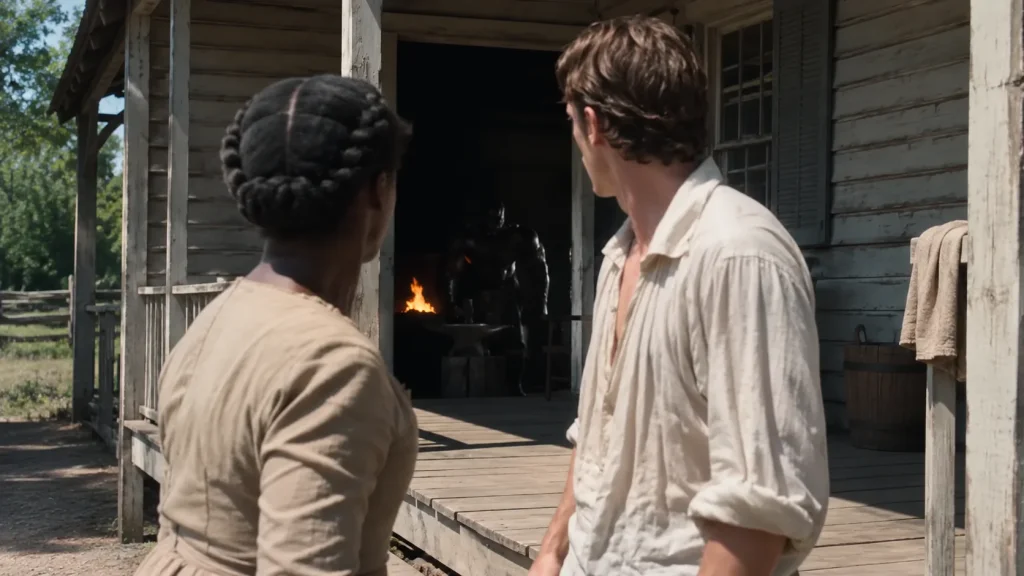
The hammer stopped in Kanga’s hand, and for the first time in years the silence from the blacksmith shop frightened the men working outside.
The overseer named Bento looked toward the open doorway and shouted for the giant to return to his work.
Kanga did not answer, because his eyes were fixed on the narrow passage behind the great house.
Miralda had disappeared into that passage with Tonico following so closely that his boots nearly touched the hem of her dress.
The boy had been laughing, but Kanga had recognized the look on Miralda’s face.
He had seen that expression on his younger sister when soldiers entered their village many years before.
The memory arrived without warning, bringing with it the smell of wet earth, the sound of running feet, and the terrible knowledge that strength could become useless when fear made a man hesitate.
Kanga placed the unfinished hinge on the anvil and stepped into the sunlight.
Bento immediately moved to block him, carrying a thin switch and the confidence of a man accustomed to obedience.
The overseer demanded to know why the work had stopped, but Kanga walked past him without turning his head.
Bento struck his shoulder with the switch, and the wood snapped against the thick fabric of Kanga’s shirt.
The giant stopped, and the entire yard seemed to wait for him to decide what kind of man he would be.
Kanga slowly turned around and looked at the broken switch lying near his feet.
He told Bento that the iron would wait, but the girl in the house could not.
The overseer stared at him, shocked less by the words than by the fact that Kanga had spoken at all.
For years the giant had answered questions with gestures, and some of the younger workers believed he had forgotten how to use his voice.
Bento recovered enough to order him back inside, threatening punishment that would last until morning.
Kanga answered that he had heard the threat and was going to the house anyway.
He continued across the yard while men carrying cane bundles slowed their steps and watched him pass.
No one followed him at first, because every person at Agua Doce understood the difference between witnessing an injustice and surviving an attempt to stop it.
Inside the great house, Miralda stood beside the locked storage room while Tonico searched his pockets for the key.
She had offered to fetch a broom from the kitchen, but he had refused with a smile that made her stomach turn.
The corridor smelled of flour, damp wood, and the expensive tobacco his father kept in a cabinet nearby.
Miralda listened desperately for the familiar footsteps of the housekeeper, Dona Celia, but the older woman had been sent to inspect the laundry sheds.
Tonico finally found the key and held it up as though he had won a prize.
He told Miralda to enter the room, and she remained where she stood.
When he reached for her wrist, she pulled back and knocked a small brass candlestick from a shelf.











