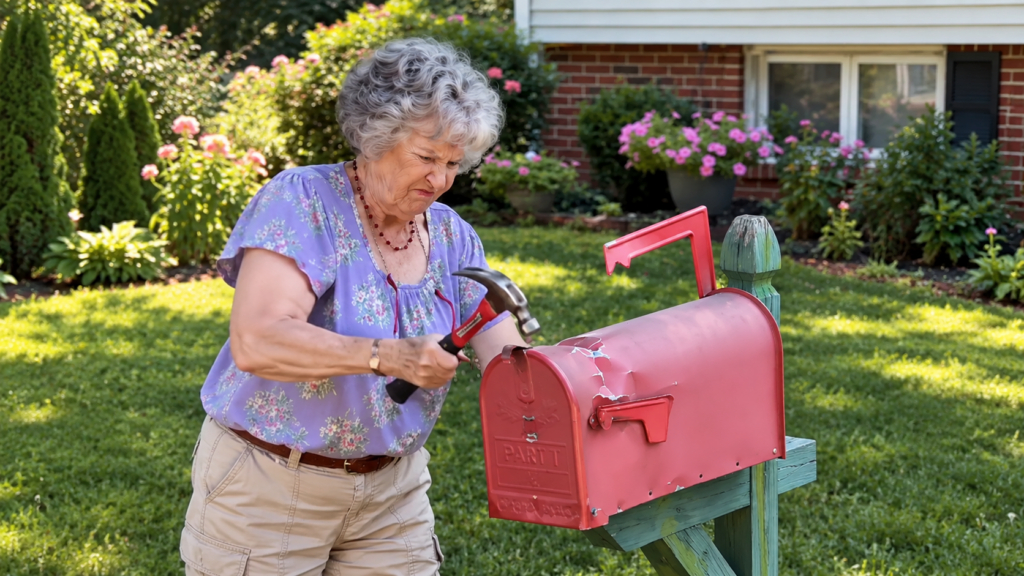
The first blow sounded like somebody had struck an empty cooking pot. The second was lower, heavier, and unmistakably deliberate.
Caleb Mercer looked up from the strip of yellow canvas in his hands. Through the front room window he saw Mrs. Odessa Vale standing beside his pink mailbox, a red-handled hammer lifted above her shoulder. She was seventy-one, narrow through the shoulders, and usually carried a folded shopping bag or a gardening trowel. She brought the hammer down a third time. The little metal door sprang loose. Another blow folded the left side inward until the box looked like an animal trying to hide its face.
Caleb dropped the canvas. He had painted that mailbox with his daughter Iris the spring before she left for college. It was the exact shade she called strawberry milk, brighter than anything on Larch Street. In the moment before he reached the door, he expected to feel anger. He felt it for perhaps half a second. Then he saw the way Odessa took her first step away.
Her left foot landed flat, too far across the center of her body. Her right shoulder sagged as though the hammer weighed twice what it should. More alarming, she did not turn toward her own house. She headed down the road toward Quarry Hill, where children were already wheeling homemade racing carts toward the annual Gravity Day starting line.
Caleb knew that walk. He had seen it in the old fairground yard, when Odessa was a mechanical inspector and a collapsing display had nearly pinned her against a fence. She had walked just like that while trying to hide a broken ankle. A person who knew her would understand what others might mistake for stubbornness: Odessa never slowed down when she was frightened.
He ran outside in a blue plaid shirt and unlaced work boots.
“Odessa!” he shouted.
She did not look back. The hammer swung at her side, its red handle bright against her gray cardigan. Caleb crossed the lawn without stopping at the ruined mailbox. He had not followed a person carrying a hammer to argue over forty dollars of folded sheet metal. He followed because of the direction she was going and because she had been at Quarry Hill twice already that week, watching the young racers with an expression he could not read.
“Stop a minute! You’re limping!”
That made her accelerate. She almost stumbled at the curb, recovered, and stepped into the narrow strip of shade cast by the parked delivery van.
“Go back inside, Caleb.”
“Not until you tell me what happened.”
“You saw what happened.”
“I saw you destroy a mailbox. I also saw you head for a street you won’t normally cross without checking the traffic twice.”











