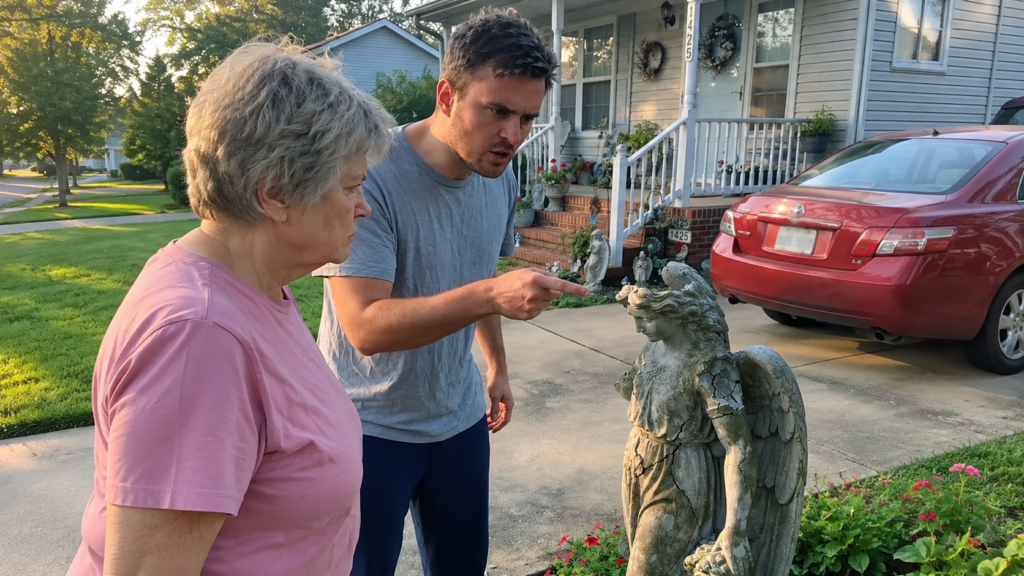
The first blow sounded like somebody striking a church bell with a brick.
Daniel Reed looked up from his breakfast and saw Carol Mercer standing beside the limestone statue at the edge of his driveway.
She had brought a carpenter’s hammer instead of the garden shears she usually carried when she marched over to complain about his hedges.
The figure was a small woman carrying a basket of pears, and its smooth face had greeted Daniel every morning since he bought the house six years earlier.
He had never particularly liked the expression, which looked less welcoming than suspicious, but the estate agent had called the statue valuable.
Carol raised the hammer again, and a pale fragment broke away from the basket.
Daniel abandoned his coffee and ran through the front door.
He reached the driveway as she struck the base for a third time.
He caught her wrist before the next swing landed, and the hammer dropped into the grass.
“What are you doing?” he demanded.
Carol pulled against his grip, then stopped when she saw the damage.
“That thing should never have been here,” she said.
“You could have knocked on my door.”
“I knocked three times last week.”
“You said my sprinklers were splashing your fence.”
“I said other things, too.”
Carol was sixty-five, narrow-shouldered and usually impossible to intimidate, but her hands were shaking hard enough that Daniel released her wrist.
He inspected the broken statue and saw a ragged crack running beneath the woman’s shoes.
A black sedan rolled to the curb before he could speak again.
A tall man in a charcoal suit climbed out with an overnight bag and walked directly toward the broken figure.
He looked at Carol, but he did not appear surprised to see her.
“Where did you get this?” he asked Daniel.
“It came with the house.”
“Who sold you the house?”
“Why should I tell you?”
The stranger crouched beside the base and gently lifted a loose wedge of limestone.
Beneath it lay a brass rectangle no larger than a matchbox, stamped with the number 04-17 and a tiny symbol resembling an open gate.
Carol made a noise like she had swallowed a mouthful of cold water.
The man took out his phone and compared the plate with a photograph showing several similar pieces.
“It’s one of the Eastmere Twelve,” he said.
Daniel had never heard the name.
Carol had, and she reached for the stone with a speed that startled both men.
The stranger intercepted her hand before she could touch the plate.
“My name is Julian Marr,” he said.
“I’ve spent eleven years trying to find this collection.”
Carol stared at him with open dislike.
“Then you’ve spent eleven years asking the wrong people,” she replied.
Julian stood and produced a business card showing a modest firm called Marr Object Research.
He explained that twelve limestone sculptures had vanished during the closure of a private sculpture garden thirty-four years earlier.
The collection had belonged to a wealthy industrialist named Arthur Bellweather, who had bought the figures from the sculptor shortly before the garden opened.
According to the story repeated in every art magazine, thieves had emptied Bellweather’s storage courtyard during a storm.
The figures had never resurfaced together, and only three uncertain photographs survived in public circulation.
Daniel looked at the damaged woman with the pears.
“You’re telling me that thing’s stolen?”
“I’m telling you it matches a missing object,” Julian said.
“Those are different claims.”
Carol laughed once, without humor.
“Congratulations, investigator, you’ve learned the difference between a story and the truth.”
She turned toward her house, but Julian called after her.
“I know about the night at the loading yard, Mrs. Mercer.”
She stopped so abruptly that Daniel could hear her shoes scrape against the sidewalk.
Julian lifted the brass plate, still attached to a fragment of stone.
“I also know somebody is offering the entire collection for sale on Saturday.”
Carol turned around.
“That is impossible.”
“I thought so until this morning.”
Daniel looked between them as a city delivery truck rattled past.
“Somebody needs to explain why my neighbor just demolished my statue.”
Carol glanced at the hammer lying among the daisies.
“Because whoever comes for the others won’t stop at the statues,” she said.
“And if that number survives, he’ll know exactly where to begin.”











