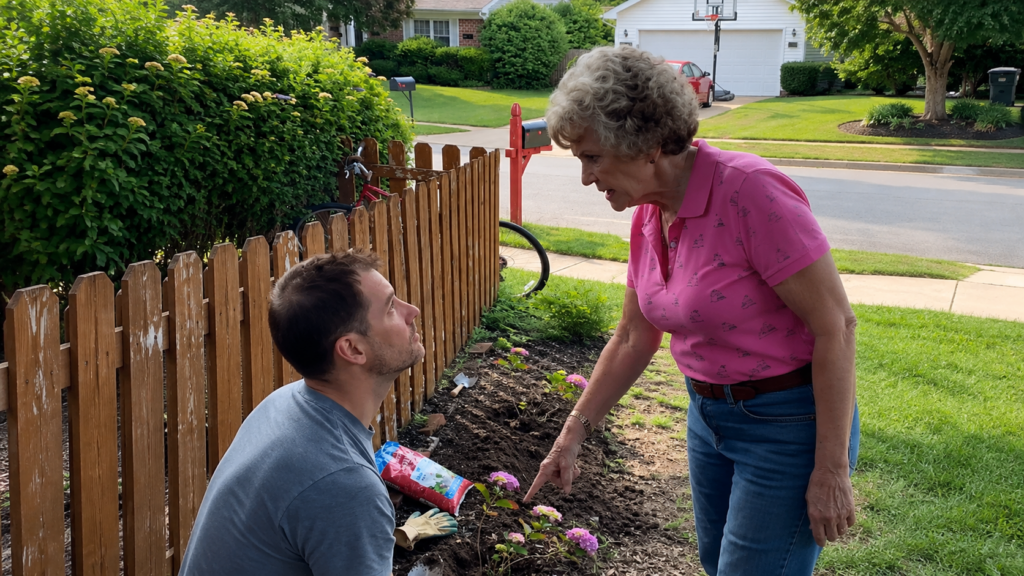
The first hydrangea had barely settled into the soil when Carol Mercer told Michael Grant that he was committing a crime.
Michael stood beside his front fence with dirt on his knees and a garden trowel in his hand.
The October sun had burned away the morning fog, leaving the street bright and ordinary.
Across the road, a boy was practicing skateboard turns between two parked cars.
Michael had selected the shrubs because his mother loved hydrangeas and because they would eventually soften the ugly wire fence.
Neither reason felt particularly criminal.
Carol pointed at the narrow strip between the fence and the pavement.
“Stop digging because that strip isn’t yours.”
Michael planted the trowel in the ground.
“I checked the survey before I bought the plants.”
“Surveys can be wrong.
”
“Then you’ll need something better than your opinion.”
Carol’s jaw tightened.
For seven years she had considered herself the unofficial supervisor of Hazel Court, a subdivision of modest brick homes built along an old industrial service road.
She corrected visitors who parked against the curb and once demanded that a delivery driver move his truck because its hazard lights annoyed her.
Michael had lived there only four months.
He already knew the sound of her shoes striking the pavement when she approached a dispute.
“My family knows this land,” Carol said.
“Then your family should know where the boundaries are.”
She took out her phone and called 911.
Michael asked her not to use the emergency number for a landscaping argument, but she turned away and described him as a man excavating disputed ground after repeated warnings.
He put down the trowel, sat on his porch step, and called the records department.
The clerk recognized his name immediately.
“Officer Vega has the copies you requested,” the clerk said.
“She’s already driving out because you asked us to confirm the parcel in person.”
Michael had requested the records three days earlier, after an electrician warned him that the fence line appeared on an old municipal access drawing.
The electrician had refused to install his planned exterior outlet until the easement question was settled.
Michael had not understood why the drawing showed a twelve-foot corridor running past six houses, while newer neighborhood pamphlets described the same strip as private landscaping.
He was beginning to understand why Carol wanted the soil left alone.
Two patrol officers arrived first.
Officer Bennett spoke with Michael while Officer Ruiz listened to Carol explain how reckless digging endangered the neighborhood.
The hole Michael had dug was fourteen inches deep and wide enough for one plant.
Bennett looked at the hydrangeas still sitting in their nursery pots.
“This seems like a survey issue,” he said.
Carol insisted that the police order Michael to fill the hole immediately.
Then a gray sedan stopped by the curb, and a woman with a canvas document case stepped out.
She introduced herself as Lena Vega, a county records officer assisting the city’s parcel reconciliation project.
Carol stared at the case as if it contained something poisonous.
“Why are you here?” she asked.
“Mr. Grant requested certified copies of six deeds connected to this block,” Vega answered.
“He also asked us to compare the handwritten exceptions against the current digital map.”
Vega spread a clean protective sheet on Michael’s porch table.
She opened a folder and arranged six deed copies in chronological order.
Three were dated within the last eleven years.
Carol’s name appeared on those three as the buyer, the seller, or the authorized representative of a small holding company called Quiet Harbor Land Services.
“Those records are wrong,” Carol said.
Vega ran a finger beneath one notary block.
“They agree with the recorded originals, the associated transfer tax returns, and the electronic index.”
“I never owned anything behind his fence.”
“You signed three documents that reference this exact parcel,” Vega said.
She tapped a description beginning at an iron survey pin beneath the northeast corner of Michael’s fence.
“The unusual part is that the parcel has changed hands six times without anyone recording a release of its access obligation.”
Officer Ruiz looked toward the narrow grass strip.
“What access obligation?”
Vega did not answer immediately.
She took a smaller drawing from the folder and placed it beside Michael’s half-dug flower bed.
A thin red line passed through the front edge of six neighboring lots, then turned behind a brick wall at the end of Hazel Court.
It connected to a paved service entrance marked FIRE APPARATUS ACCESS.
Michael stared at the line.
“There’s a fire lane under our front gardens?”
“The route was designed as emergency access for a building that doesn’t appear on your subdivision map,” Vega said.
Carol’s complexion changed.
“That building was taken off the plans years ago.”
“I didn’t tell you which building,” Vega replied.
For the first time that morning, Carol said nothing.











