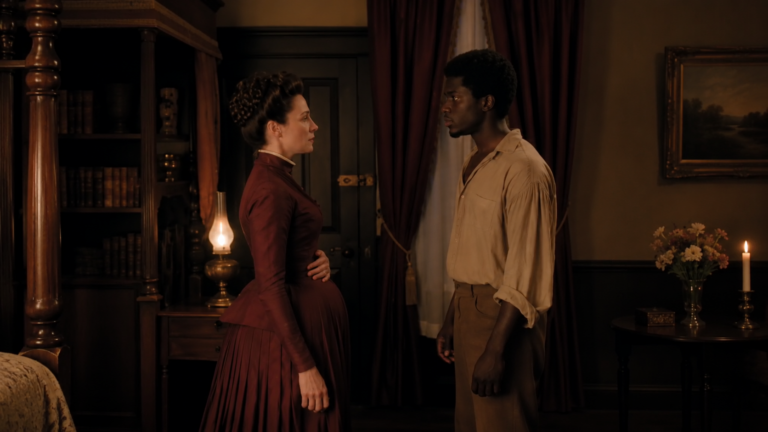
“It was a transfer station on the western road,” he said.
“Who owned it?”
“The company was registered under another name.”
“Which name?”
Daniel hesitated.
He had seen an initial in the ledger but not the complete word.
Catherine removed a second page.
The receipt carried a company seal.
A stylized bell stood above a river.
Daniel recognized the mark on the crates he had built.
The symbol had been hidden beneath the tarpaulin, but he had seen its outline when Silas unloaded them.
Catherine watched his expression change.
“You know it.”
“I’ve seen it on transport crates.”
“What sort of transport?”
Daniel looked toward the open doorway.
“People.”
The room became very quiet.
Catherine folded the receipt.
“I can take these papers to a magistrate.”
“Which magistrate?”
“Mr.
Hollis in Richmond has known my family for years.”
“Has he known your husband for years too?”
She looked away.
Daniel continued without raising his voice.
“You may be believed because of your name, ma’am, but my people won’t be safe just because you hand him a packet.”
Catherine sat down.
“I am trying to help.”
“Then don’t confuse being heard with being trusted.”
His words hurt her.
He did not apologize.
She asked what would be needed to make the evidence impossible to dismiss.
Daniel thought of Mercy in the cellar, the false funeral record, the doctor’s payments, and the children Margaret had described.
“We need witnesses who can leave this place alive,” he said.
“And we need copies that your husband cannot burn.”
Catherine looked toward her sewing basket.
She understood at last that the packet was not a secret to be guarded in her bedroom.
It was evidence that needed to exist beyond the reach of Blackwood House.
Chapter 13: The Reverend Who Listened
Reverend Thomas Avery believed a man should carry his conscience like a lantern, even when his neighbors preferred the dark.
He had preached at the Blackwood chapel for seven years.
During that time Richard had provided timber for the church, paid for hymnbooks, and insisted on sitting in the front pew.
The minister accepted the gifts but grew increasingly uneasy about their price.
He had seen families separated after Richard made public declarations about the sanctity of marriage.
He had seen a young woman punished for speaking to a visiting teacher.
He had heard whispered accusations against Silas Rook, none of which could survive a meeting with the plantation’s paid overseers.