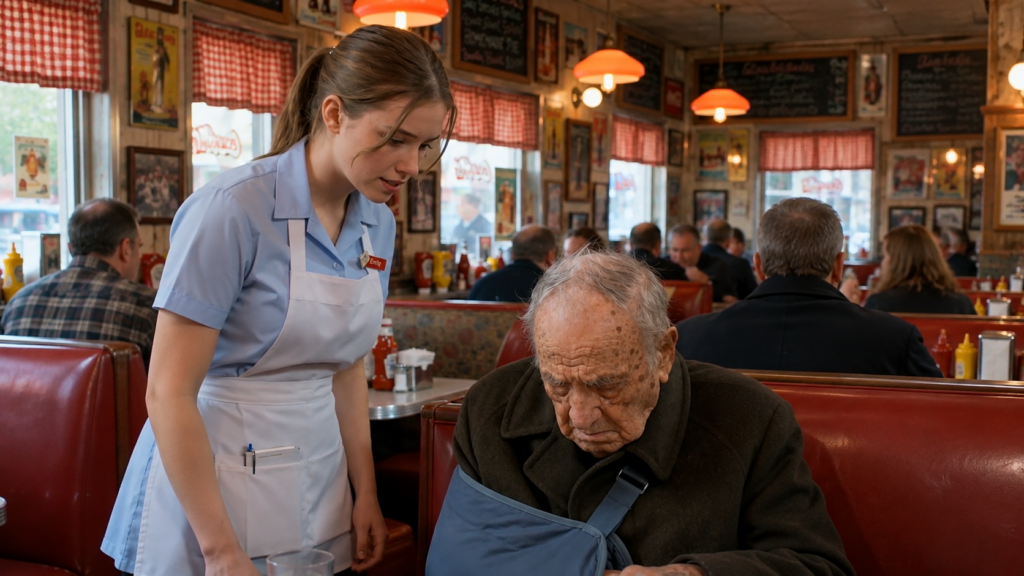
Emily Carter noticed the elderly man struggling to cut his dinner with one hand wrapped in a sling.
He had ordered meatloaf, mashed potatoes, and green beans, but his knife kept sliding sideways across the plate.
The dining room at Larkin’s Grill was busy enough that the other servers had stopped looking toward his booth.
Emily carried an extra napkin across the room and asked whether he wanted help.
The man hesitated as if accepting assistance cost him something he could not afford.
“I don’t want to trouble you,” he said.
“You won’t,” Emily replied.
She pulled the empty chair close enough to reach his plate without leaning over him.
“Tell me how you like the pieces cut.”
He considered that question longer than she expected.
“Small enough that I can manage them with a fork.
”
Emily worked carefully, keeping the gravy away from the sling, and returned the plate within reach.
A woman at the next table complained that she had been waiting for coffee.
Emily apologized, refilled the woman’s cup, and came back with fresh bread for the old man.
He had barely touched his dinner while she was gone.
“I thought you were hungry,” Emily said.
“I am,” he replied.
“Then something’s wrong.”
He glanced at the yellow light above their booth.
“You look familiar.”
Emily laughed and told him the restaurant had been here for twenty years.
“Perhaps you’ve seen me working.”
He shook his head.
“You remind me of a girl who used to sit in the projection booth and ask why the endings always came first.”
A picture rose unexpectedly in Emily’s mind: a stairway painted green,
an old brass railing, and the smell of warm dust.
But a shout from the kitchen interrupted her.
The man smiled, apparently deciding not to chase a memory that belonged to another century.
Before he left, he thanked her and asked her full name.
“Emily Carter,” she answered.
He closed his eyes for a moment.
“Of course,” he whispered.
She did not know what he meant.
The next evening, a well-dressed man entered carrying a yellow envelope.
He was in his late forties, with a raincoat folded over one arm and the careful expression of someone entering a conversation already in progress.
He waited until Emily finished carrying two plates to a corner table.
“Are you Emily Carter?”
“Yes.”
He placed the envelope on the counter.
“My father was the man you helped last night.”
“How is his arm?”
“Painful, but healing.”
Emily glanced at the envelope.
“What is this?”
“Something he’s carried for years.”
The man looked toward the dining room as if concerned that another customer might overhear.
“After meeting you, he finally decided who should have it.”
Emily lifted the envelope without opening it.
“Why me?”
“Because you were there the night the Beacon Theater closed.”
The words landed harder than he could have intended.
Emily had not heard the Beacon mentioned in years.
“Who are you?”
“Adrian Bell.”
He swallowed and added, “My father is Thomas Bell.”
Emily remembered that name immediately.
Thomas Bell had run the projection room at the Beacon, a narrow independent cinema where her mother had taken her every Friday until the building closed.
The final night had ended in shouting, police lights, and an accusation that Emily’s mother had stolen the money collected to keep the theater open.
Her mother had been a volunteer treasurer.
She had denied taking anything, but the rumor followed her until she left the neighborhood.
Emily had been fourteen, old enough to understand humiliation and too young to know what proof might have stopped it.
Her mother had died six years later without anyone publicly correcting the accusation.
“You can take that envelope back,” Emily said.
Adrian left his hand resting beside it.
“You should know what’s in there first.”
Emily slit the flap with the edge of a butter knife.
Inside lay a faded program from the Beacon’s final screening, a small paper ticket marked ROW G SEAT 12, and a strip of cream-colored cardboard.
Across the cardboard were six circles made in pencil.
Three had been filled in completely.
Underneath them, in a child’s handwriting, were the words, IF THE LIGHT GOES OUT, START WITH THE SECOND REEL.
Emily recognized the handwriting.
It was hers.
She could remember making the note as vividly as she remembered the theater’s velvet seats.
At the bottom of the envelope lay a single photograph of the Beacon’s projection room, taken after it had been emptied.
A metal film can stood on the windowsill.
Someone had painted a bright blue arrow on the lid.
“What am I supposed to do with this?” she asked.
“My father says the accusation against your mother began with that can.”
“That doesn’t make sense.”
“It didn’t to him either until he found out what happened after closing night.”
Emily looked up sharply.
“He waited seventeen years to tell me?”
Adrian did not defend him.
“He says he was ashamed.”
“Shame doesn’t give my mother her life back.”
“I know.”
“Do you?”
Adrian accepted the question without answering.
Then he put a folded sheet beside the envelope.
It was a notice from the city announcing that the Beacon building would be cleared and sold after the weekend.
The date was only four days away.
“My father was in the building yesterday,” Adrian said.
“That’s how he hurt his arm.”
Emily stared at him.
“Doing what?”
“Trying to reach the projection booth before the demolition crew removes the stairs.”
“Why?”
“Because he thinks the film can is still there.”
Emily looked again at the blue arrow.
The photograph showed a small scrape in the lid, shaped like a half-moon.
She remembered that scrape too.
And suddenly she remembered why she had written those strange words about the second reel.
On closing night, she had been watching the projectionist prepare a surprise film about the neighborhood.
It never played.
Instead, the lights went out, the screen went white, and someone shouted that the donation box was missing.











