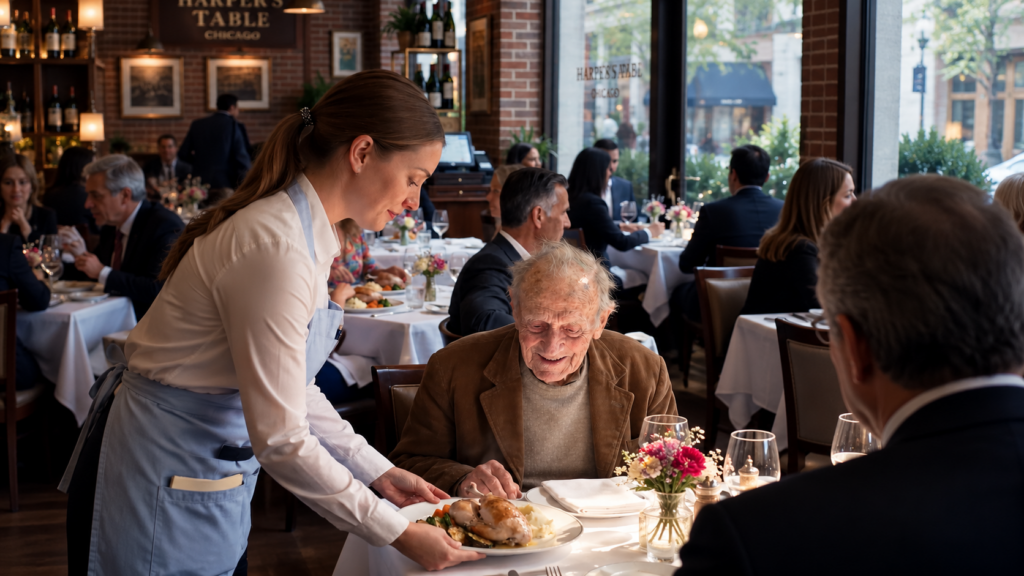
The chicken was still steaming when Calvin Rusk crossed the dining room.
Marissa knew the manager’s angry walk before he reached her table.
He moved fast when he wanted an audience and slowly when anyone needed help.
The elderly customer had taken only three bites.
His name was Walter, although Marissa had learned that only a minute earlier.
He sat near the window with a brown coat folded carefully over his knees.
His hands trembled slightly as he held his fork.
Calvin stopped beside the table and stared at the plate.
“Who authorized this?” he asked.
Marissa stood straighter.
“I did.”
“Did he order it?”
“I gave it to him.”
“Did he pay for it?”
“I was going to cover the cost.”
Several guests turned in their seats.
Calvin noticed and raised his voice.
“You are not authorized to give food away in my restaurant.”
Walter put his fork down with painstaking care.
“I can leave,” he said.
“You don’t have to,” Marissa answered.
Calvin pointed toward the service station.
“You do.”
Marissa felt heat climb her neck.
“Calvin, we can talk in the kitchen.”
“There is nothing to discuss. You’re fired.”
An awkward stillness spread from table to table.
A server carrying two glasses paused near the bar.
The cook at the pass leaned forward, apparently unable to believe what he had heard.
Marissa looked once at the man whose lunch had started everything.
Walter’s face had gone pale.
“This is not his fault,” she said.
“I didn’t ask whose fault it was,” Calvin replied.
He extended his hand for her apron.
Marissa untied the pale-blue strings herself.
She folded the apron in three careful movements and placed it on the counter.
Her fingers were shaking by the time she finished.
The folding mattered because it gave her something to do besides cry.
Her shift had barely reached its second hour.
She had rent due on Tuesday, a grocery list at home, and a prescription waiting at the pharmacy.
Her mother, Elena, needed medicine after a complicated heart procedure.
The co-payment had increased again that morning.
Marissa had brought lunch from home so she could put the difference toward the prescription.
She could have told Calvin all of this.
He already knew she needed the hours.
“Someone else can cover your tables,” he said.
“They will need my checks transferred first.”
“Leave the checks.”
“Table nine has an allergy that isn’t on their printed order.”
“Marissa.”
She wrote the information on a notepad and set it beside the register anyway.
Then she walked out into a Chicago afternoon bright enough to make her eyes ache.
She reached the corner before checking her phone.
Her mother had sent a picture of their houseplant finally producing a flower.
Under it, Elena had written that good things sometimes took longer than expected.
Marissa sat on a low stone wall outside a bank and stared at the message.
She did not know how to tell her mother that she had lost the job.











