The old man arrived at the Briar Street Diner at 5:17 on a Thursday morning, when the windows were still black and the cook was arguing with a broken toaster.
Daniel Brooks noticed the bandage first. It covered the stranger’s left hand from the knuckles to the wrist, but the fingers were exposed and badly swollen. The man wore a wool coat too heavy for the weather and carried himself with the careful dignity of someone determined not to ask for help.
“Counter or booth?” Daniel asked.
“Somewhere I can see the door.”
Daniel pointed to the second booth. The man ordered eggs, toast, and coffee, then sat looking at the untouched silverware. When Daniel brought the plate, the stranger attempted to lift his fork. His fingers trembled. He set it down before anyone could notice.
Daniel noticed anyway.
“Need some help?”
The man looked at the floor. “I can’t hold the fork steady.”
Daniel fetched a clean knife, cut the eggs and toast, opened the syrup, and replaced the heavy mug with a lighter cup. He did it without an audience and without the cheerful pity that could make assistance feel like a performance.
From the register, his manager, Kent Voss, called, “You’re not paid to babysit customers.”
Daniel didn’t turn. “I’ll take care of table six next.”
“You’ll take care of it now.”
“Then you can fire me after breakfast.”
The old man watched this exchange with an expression Daniel could not read. After eating, he studied Daniel’s name tag.
“Brooks,” he murmured. “I knew that name once.”
“There are a lot of us.”
“Not as many as there should have been.”
He left enough cash for the meal and a modest tip, then paused outside as though deciding whether to come back. A gray delivery truck rolled past. The old man flinched at the sound of its loose tailgate.
Daniel thought about that strange reaction until the morning rush erased it.
Chapter Two: The Dossier
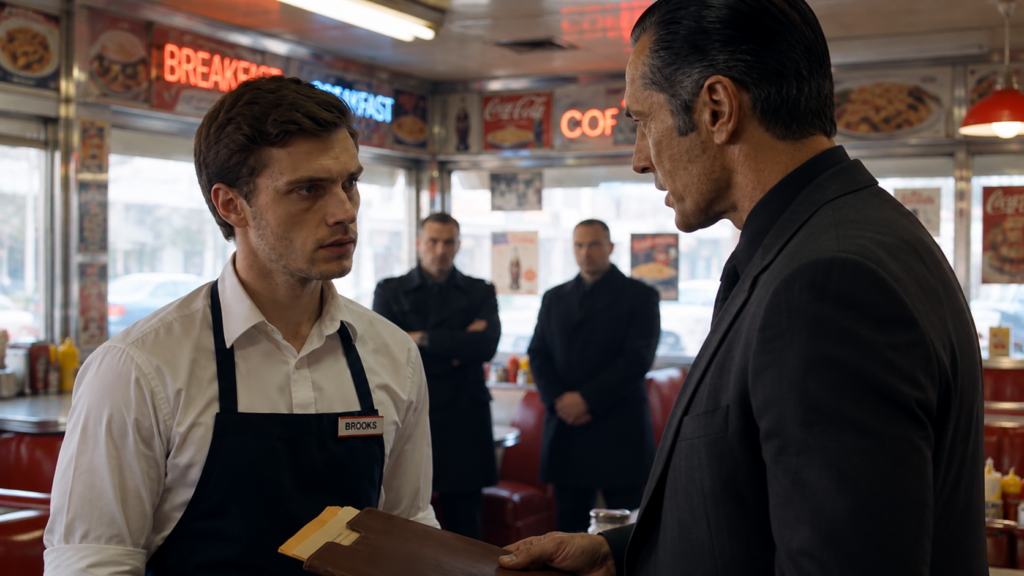
At 6:03 the next morning, a black sedan stopped across two parking spaces. A tall man in a charcoal suit emerged, followed by two men who stood by the entrance rather than entering. He carried a leather dossier beneath one arm.
The diner grew quiet when he asked, “Which one of you is Daniel Brooks?”
Daniel raised his hand. Kent appeared beside the coffee machine, suddenly eager to be useful.
“I’m Adrian Vale,” the visitor said. “You helped someone yesterday.”
He placed the dossier on the counter. Inside were photographs of storefronts, clipped articles about a waterfront strike, addresses in three states, and pages on which BROOKS appeared in different handwriting. At the center lay a photograph of the injured old man, decades younger, beside a row of freight containers.











