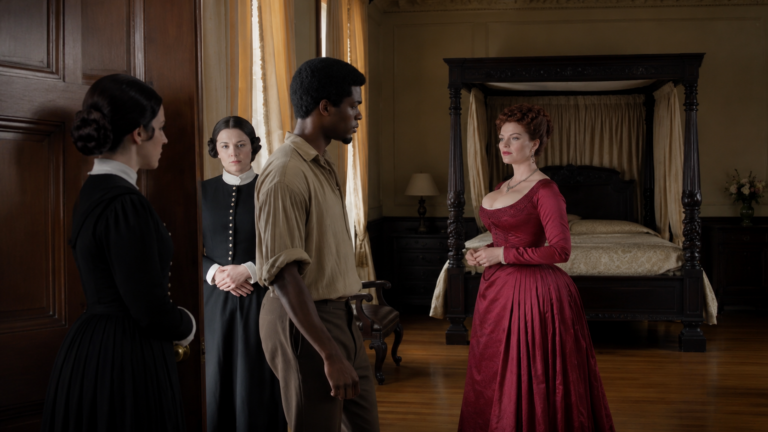
CHAPTER SEVENTEEN — A DOCTOR’S VISIT
Dr. Bell arrived after midnight in a mud-spattered carriage pulled by a tired mare.
He was an aging physician with a slow voice and a habit of listening before reaching for his instruments.
Evelyn met him at the kitchen steps.
“There are three people who need you most urgently,” she said.
“A boy with a damaged ankle, a woman who cannot put weight on her foot, and a young man with a head injury.”
Arthur appeared behind her.
“My wife has misunderstood the seriousness of the situation,” he said.
“You need not stay long.”
Dr. Bell looked at the broken upper windows.
“I hear you had a difficult night.”
“We did,” Evelyn replied.
“I would like you to examine them before you leave.”
The doctor glanced between husband and wife.
“I can do that,” he said.
Arthur walked away without thanking him.
The examination took nearly two hours.
Ben’s ankle was badly swollen, but the doctor found no clear evidence of a broken bone.
May needed rest and a firm wrap around her ankle.
Samuel’s head wound was superficial, though his shoulder required several days without heavy lifting.
Dr. Bell delivered these findings in the kitchen with Arthur present.
“These people cannot safely return to heavy work tomorrow,” he said.
Arthur folded his arms.
“They will be given suitable duties.”
Evelyn watched Voss standing in the doorway.
The overseer made no objection while the doctor remained.
When Dr. Bell asked how the building had failed, Elias’s broken beam lay near the kitchen door.
The physician examined the splintered wood and said he would advise against occupying the south portion of the house until a carpenter inspected it.
Arthur looked offended.
“I have already arranged repairs.”
“Then ask the carpenter to inspect the whole roof first,” the doctor replied.
“I have no desire to treat another household beneath a falling ceiling.”
After the carriage left, Voss ordered Peter to carry tools to the damaged gallery.
Peter looked toward the roof and did not move.
“Mr. Voss,” he said, “that wall is still leaning.”
The overseer raised his hand.
Arthur appeared at the door and told him to lower it.
“Not tonight,” Arthur said.
For one moment Evelyn thought she had finally reached him.
Then he turned to her.
“You have made a public spectacle of private matters,” he said.
“Tomorrow we will decide how to put this house back in order.”
Evelyn understood that he meant more than the building.
She went to the smokehouse and found Ruth sitting beside Josie.
The child was sleeping with her fingers curled around a corner of her mother’s apron.
“I don’t know what tomorrow will bring,” Evelyn said.
Ruth looked up with weary eyes.
“We rarely do, ma’am.”
“But the doctor has said the injured people must rest.”
“Will Mr. Voss listen?”
“He listened while Dr. Bell was here.”
Ruth looked toward the yard.
“Then he’ll listen until the doctor’s wagon is out of sight.”
Evelyn could not argue.
CHAPTER EIGHTEEN — THE BEAM EVERYONE HAD SEEN
Morning brought clearer skies and a pale line of sunshine across the ruined gallery.
Arthur summoned Elias Ward back to Brierwood because no other carpenter could reach the property before the roads cleared.
He made the invitation through a hired messenger rather than speaking to the man himself.
Elias arrived carrying a carpenter’s square and a folding rule.
Samuel stood nearby with his injured arm in a sling while Peter helped examine the lower wall.
“I want a plan to rebuild,” Arthur said.
“You need a plan to remove what’s still dangerous,” Elias replied.
“The repair can follow.”
They walked around the broken gallery together.
Elias placed one hand against the old brickwork and showed where the settling roof had separated the lime mortar.
“That wall needs support before anyone works above it,” he said.
Arthur asked how many days the job would take.
“That depends on whether you use sound timber,” Elias answered.
“I will not put my name to another shortcut.”
Voss complained about the expense.
Elias held up the carpenter’s square.
“I was hired to tell you whether a wall would stand, not whether you liked my answer.”
Arthur turned to Samuel.
“You worked on this addition.”
“Yes, sir.”
“Did you understand the beam was unsound?”
Samuel took a breath.
“We found rot when we cut it.”
“Then why did you fasten it?”
“Mr. Voss ordered us to.”
“And you did not tell me?”
“Mr. Ward told you before the work continued,” Samuel replied.
The courtyard went silent.
Arthur’s eyes narrowed.
Evelyn stood beside the kitchen steps and waited.
She had spent the night anticipating anger, but hearing Samuel answer without lowering his head changed something in the air.
Arthur looked toward Elias.
“Did you warn me directly?”
“I did,” the carpenter said.
“On the day you dismissed me.”
Arthur stared at the fractured joint for a long time.
At last he turned toward Voss.
“Stop work on the south side until Ward signs off.”
Voss protested.
“The tobacco shelter needs repair.”
“Then repair the shelter,” Arthur said.
“Not this wall.”
Samuel looked away as though unwilling to show relief.
Evelyn understood that the decision concerned the building, not the people’s rights.
It would not undo the violence of their lives or the power Arthur held over them.
Still, one dangerous wall would not be rebuilt the same way.
That was the first practical change she had been able to force into the open.