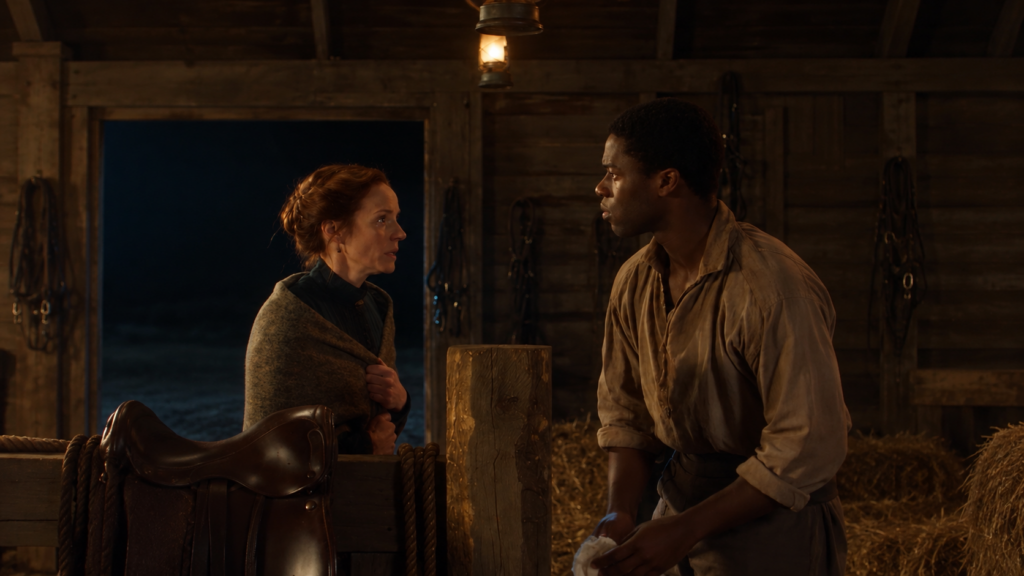
Virginia, October 1854.
The lantern above the injured mare swayed when Catherine Vale entered the stable.
Samuel had heard her approaching along the gravel path, but he kept his attention on the animal’s swollen foreleg.
The horse needed a clean dressing before daylight, and he had no intention of letting a frightened woman from the big house turn that work into another dangerous conversation.
“My husband has gone to Richmond,” Catherine said.
Samuel tied the bandage and checked the mare’s breathing.
“Then I hope his journey is comfortable, ma’am.”
“Come to the house with me.”
Samuel straightened slowly.
“I belong in the stable.”
She stepped between him and the doorway.
Her shawl was loose, and her hair had come free of the pins that normally made her look like a portrait hanging in a dark room.
For a moment she seemed younger than the woman who had presided over the Vale dining table for twelve years.
“My husband means to send me away,” she said.
Samuel glanced past her toward the empty yard.
“Then you should speak to him.”
“He will replace me with a woman who can give him an heir.”
“Your marriage is not something I can mend.”
She moved closer.
“You don’t understand what kind of marriage it is.”
“I understand enough to know I cannot become its answer.”
He had spoken softly, but she recoiled as though he had shouted.
Then Catherine took a bundle of folded papers from beneath her shawl.
She separated one from the others and held it where the lantern illuminated the handwriting.
The first line began with an intimate greeting addressed to her husband,
Julian.
Samuel knew the lettering before she named its author.
Martin Kersey, a polished gentleman from Charlottesville, spent three weeks at Vale House every spring.
He rode beside Julian, dined with him, and stayed in the room that connected to Julian’s private study.
“Martin wrote these,” Catherine said.
Samuel looked away from the letter.
“I cannot tell you what they mean.”
“Read the last one.”
The final envelope had been addressed in a hand Samuel recognized from the labels on the stable’s supply crates.
Across its lower corner someone had written his name.
Samuel did not reach for the envelope.
Catherine unfolded the page herself.
“The carriage is to be prepared on Thursday,” she read, and her voice tightened.
“Catherine must be occupied with the question of Samuel, for there can be no scandal concerning us if everyone is discussing hers.”
The horse shifted against its stall gate.
Samuel heard the small metallic sound of the latch and felt his stomach contract.
Catherine kept reading.
“The likeness will be ready by noon, and the assembled guests will see what we require them to see.”
She lowered the letter.
“I thought they meant to accuse me of taking you as a lover.”
“They do.”
“You haven’t heard the rest.”
Samuel finally took the paper.
There were three additional lines, written more hurriedly than the opening passage.
“Samuel must appear in the window behind her, whether he understands his part or not.”
“He must be seen carrying the blue cloak.”
“After the announcement, he will be removed where no contradiction may reach the county.”
Samuel read the final sentence twice.
The word removed was ordinary enough to conceal almost anything.
The stable seemed suddenly smaller.
Catherine watched him with an expression in which panic and expectation struggled for possession.
“You see why I need your help.”
He passed the letter back.
“I see why you came looking for someone you could force to help.”
“That isn’t fair.”
“Neither is a woman who owns my labor telling me that I must save her marriage.”
Catherine flinched again.
Samuel pointed to the open door.
“Whatever those men intend, they have chosen my name because they expect nobody to ask me what happened.”
“Then tell me what to do.”
“First, move away from that door.”
She obeyed.
He lifted the lantern, finished his work on the mare, and waited for Catherine to realize that he would not follow her into the house.
Only when he set the dressing bowl aside did he speak again.
“Who is making the likeness?”
“A photographer from Richmond.”
“Where is he staying?”
“In the old schoolroom beside the kitchen.”
Samuel remembered the crates delivered that afternoon, their glass panels padded in straw and their labels painted with instructions against sunlight.
He had assumed the man intended to make family portraits.
He had not considered what those portraits might be designed to prove.
“Will your husband return before Thursday?”
“He is expected tomorrow.”
“Then you have one day to decide whether the truth matters more than what happens to your name.”
Catherine’s mouth opened.
Samuel stopped her before she could promise him anything.
“I will not trade my life for your reputation.”
He turned away to extinguish the extra lamp.
When he looked back, Catherine was still standing outside, holding the letter as if it might burn her fingers.











