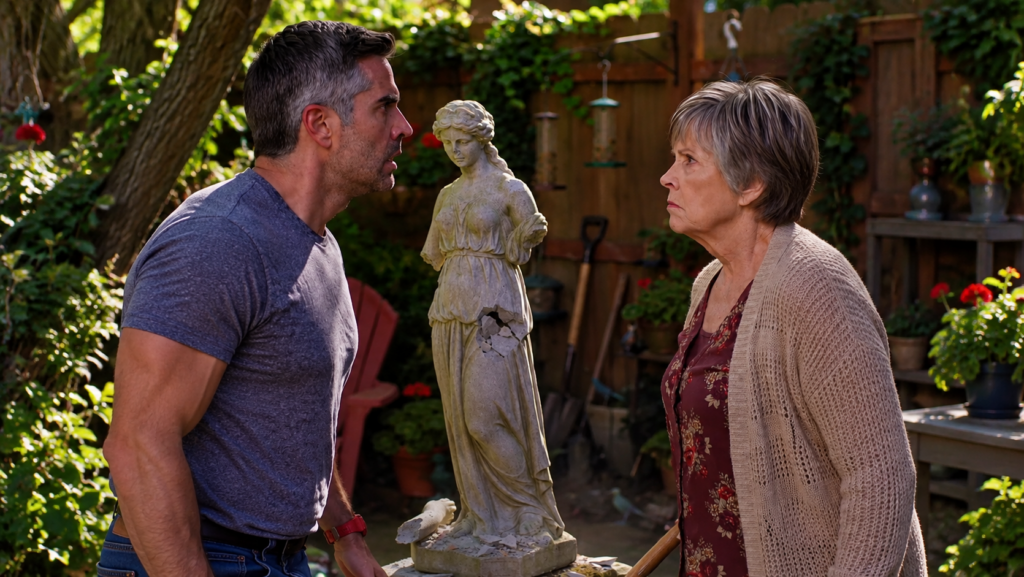
Daniel Reed heard the first crack from the kitchen, where he was washing a coffee cup that still smelled faintly of yesterday’s rain.
The second crack came before he reached the back door.
His neighbor Carol Mercer was standing beside his stone statue with a hammer lifted above her shoulder.
One of the figure’s arms lay in three pieces on the brick path.
Daniel threw open the door.
“Carol, what are you doing?”
She swung again, striking the figure’s shoulder with a sound that made his teeth hurt.
“That thing should have been removed years ago,” she said.
“Get away from it.”
He stepped between her and the statue, careful to keep his hands where she could see them.
Carol held the hammer at her side but did not retreat.
“You have no idea what you’ve put in this yard.”
“I know what I paid for it.”
“Money doesn’t make something belong here.”
“You crossed my fence to destroy it.”
Daniel pulled out his phone and called emergency services while Carol watched with an expression almost like relief.
The statue had stood under the silver maple for eight months.
It showed a woman in work clothes holding a folded cloth against her chest, her face turned toward an invisible companion.
Daniel had purchased it at a small estate clearance outside Marlow, where the seller described it as an unsigned regional carving.
He had loved the patience in its expression before he ever learned it might be valuable.
A black sedan stopped at the curb while he was still speaking with the dispatcher.
A gray-haired man in a dark suit hurried through the side gate carrying a narrow leather case.
“Mr. Reed?”
“Who are you?”
“I’m Adrian Vale, the appraiser who called yesterday.”
Adrian stopped when he saw the broken arm.
Carol’s face lost its color so quickly that Daniel noticed even through his anger.
“Please tell me nobody moved the base,” Adrian said.
“She was breaking the whole thing,” Daniel replied.
Adrian knelt and examined the cracked plinth with a small flashlight.
He brushed away a loose flake of stone, revealing a crescent containing three shallow vertical cuts.
“I was afraid of this,” he whispered.
Carol moved toward the gate.
“Stay,” Daniel said, keeping his distance.
Adrian stood slowly.
“Mrs. Mercer knows what that mark means.”
“You don’t know me,” Carol replied.
“I know your family commissioned the original memorial series in 1987.”
Daniel looked from one face to the other.
“What series?”
“Twenty-four stone figures for the workers killed in the Havers Mill collapse,” Adrian said.
“The Mercer Foundation collected money from their families for individual memorials.”
Carol tightened her fingers around the hammer.
“Those arrangements were private.”
“Every family was told its memorial was being made,” Adrian continued.
“Most never received anything.”
He pointed at the crescent.
“That mark was put on the models before the inscriptions were added.”
“So?” Daniel asked.
“So the stone in your garden is not simply a sculpture somebody forgot.”
Adrian looked directly at Carol.
“It is the first physical proof that the missing memorials were actually made.”
Carol opened her mouth, then seemed to reconsider every word she might say.
A siren sounded at the far end of the street.
Daniel looked at the shattered arm on the bricks.
He had thought he was protecting an expensive object from an unreasonable neighbor.
Now he suspected he was standing in the middle of a grievance far older than his house.
CHAPTER TWO — A WOMAN WITH TWO NAMES
The responding officer was a young woman named Leah Cortez who took photographs before asking anyone to touch the pieces.
Carol explained that she had been distressed by a dangerous sculpture, but Leah asked whether the hammer belonged to her.
Carol admitted that it did.
Daniel showed the officer his purchase receipt and the messages in which Carol had demanded that he remove the statue.
Adrian explained what he knew without pretending to have proved what happened to the missing sculptures.
“You’re making accusations about dead people,” Carol said.
“I’m identifying a maker’s mark,” Adrian answered.
Leah separated their statements and arranged for the broken stone to remain where it was until Daniel could have it collected safely.
Carol went home without the hammer, which the officer retained as evidence.
Her parting words were directed at Adrian rather than Daniel.
“You should have stayed away from our family.”
Once the patrol car had gone, Adrian sat on Daniel’s back steps and opened his case.
Inside were photographs of sculpted hands, newspaper notices, and a grainy image of the Havers Mill workforce gathered beside a brick building.
Daniel recognized the woman’s posture from his statue, although the person in the photograph wore an apron and had both arms intact.
“Who is she?”
“Her name was Inez Salazar,” Adrian said.
“She supervised the night sorting room.”
“Was she killed in the collapse?”
“Yes, along with twenty-three other people.”
Adrian handed Daniel a photocopy of a newspaper advertisement.
The headline announced a permanent garden of remembrance commissioned by the Mercer Foundation.
Each family was promised a full-size stone figure based on a surviving photograph, with a place for the person’s name and a short personal inscription.
“Who paid?” Daniel asked.
“The foundation raised public donations, but many families also contributed directly.”
“Why didn’t they get their statues?”
“The foundation said the sculptor abandoned the contract after a quarry fire.”
“Did he?”
“That’s what I came here to find out.”
Daniel glanced at the broken shoulder.
“You knew what it was before you arrived?”
“I suspected.”
“You could have warned me yesterday.”
“I called three times yesterday, Daniel.”
Daniel remembered silencing his phone during a meeting and then forgetting to return the calls.
Adrian did not use that fact to defend himself.
“I should have written something clearer,” he admitted.
“Why does Carol care?”
“Her father chaired the foundation, and her mother managed the project.”
“That was nearly forty years ago.”
“The families are still here.”
Adrian pointed to the figure’s face.
“This particular memorial was supposed to belong to Inez’s daughter.”
Daniel felt a sudden unease.
“What daughter?”
“A woman named Rosa Salazar, who is sixty-one now.”
“Does she know about this?”
“Not yet.”
Daniel looked out at his maple tree.
He had planned to replace the statue’s missing arm if he could find a skilled conservator.
Instead he was considering whether the entire object belonged in his garden at all.
“Then we need to tell her,” he said.
Adrian shook his head gently.
“We need to tell her what we know, not what we wish were true.”
“What is the difference?”
“The mark establishes a workshop and a commission, not where the finished figures went.”
Daniel picked up his phone.
“Then we start with the people who paid for them.”











