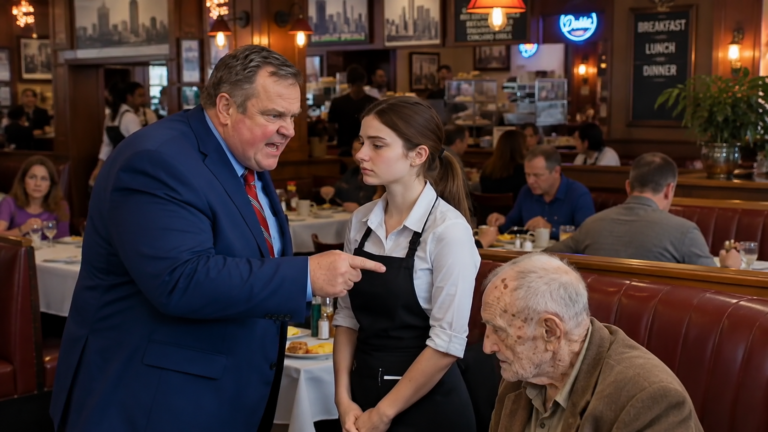
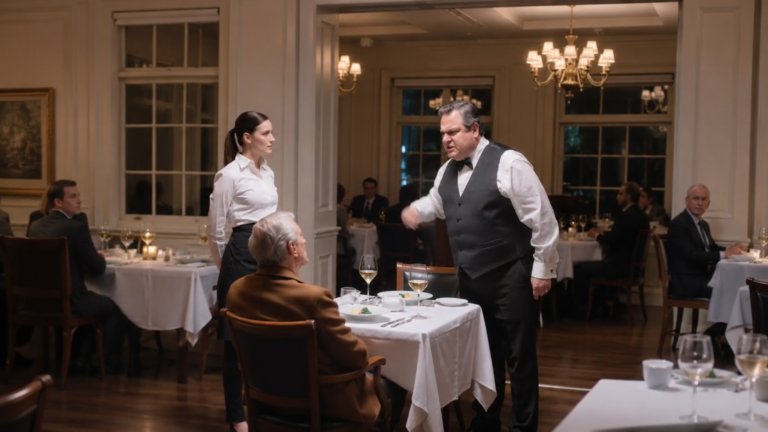
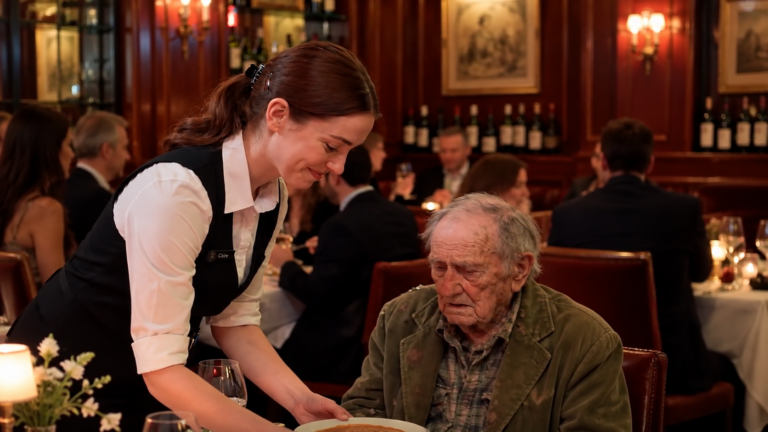
She did not miss Victor’s attention.
She did miss some of the Waverly Room’s staff and the feeling of a dining room moving together during a busy evening.
One afternoon a patient asked her whether she was the waitress from the newspaper.
Claire admitted she was.
The woman said she had worked in food service for forty years and remembered managers who treated kindness as an expense.
Claire asked whether the woman had eaten lunch.
The patient laughed and said she was hungry.
Claire brought the meal listed on her ticket, then returned to work.
The moment was ordinary, which made it quietly satisfying.
The investigation into Dorian’s invoices advanced when a former bookkeeper named Iris Cole agreed to speak.
Iris had worked for Metropolitan Hospitality Services during the years when the employee participation records were altered.
She remembered being instructed to move certain expenses from consulting accounts to reserve accounts at the end of reporting periods.
She had questioned the classifications but accepted the explanations given by her supervisor.
Years later she discovered that several supporting invoices were missing from the archive.
Iris provided copies of her contemporaneous notes and explained where the accounting system stored audit logs.
Sheila verified that some entries had been changed after the periods closed.
She did not assume Iris had been innocent of every error, and Iris did not ask to be portrayed that way.
She acknowledged making adjustments without obtaining adequate support.
Her willingness to describe her own role made the testimony more credible, though it also exposed her to difficult questions.
Dorian’s counsel challenged the reliability of her recollections and emphasized that the accounts had been reviewed by outside professionals.
Sheila requested the actual review letters.
Several contained limitations stating that the accountants had relied on management representations rather than conducting full audits.
The distinction changed the meaning of Dorian’s repeated claim that professionals had approved everything.
A review could raise questions without guaranteeing that every number had been independently tested.
At a conference with the affected parties, Audrey explained the findings in plain terms.
Money that should have been separately tracked had been mixed with operating accounts, and some payments had reached entities tied to the consultant.
The total potential shortfall remained under calculation because not every transaction was improper.
Claire asked whether the investigators had established who created Ruth’s disputed signature.
Audrey said that the evidence pointed toward a document-preparation process controlled by Dorian’s office, but no one could responsibly identify the person who put pen to paper without more proof.
Claire felt the familiar urge to fill the gap with anger.
Her mother’s signature had been used on a document that might have affected the family, and the possibility that the signer would never be identified was painful.