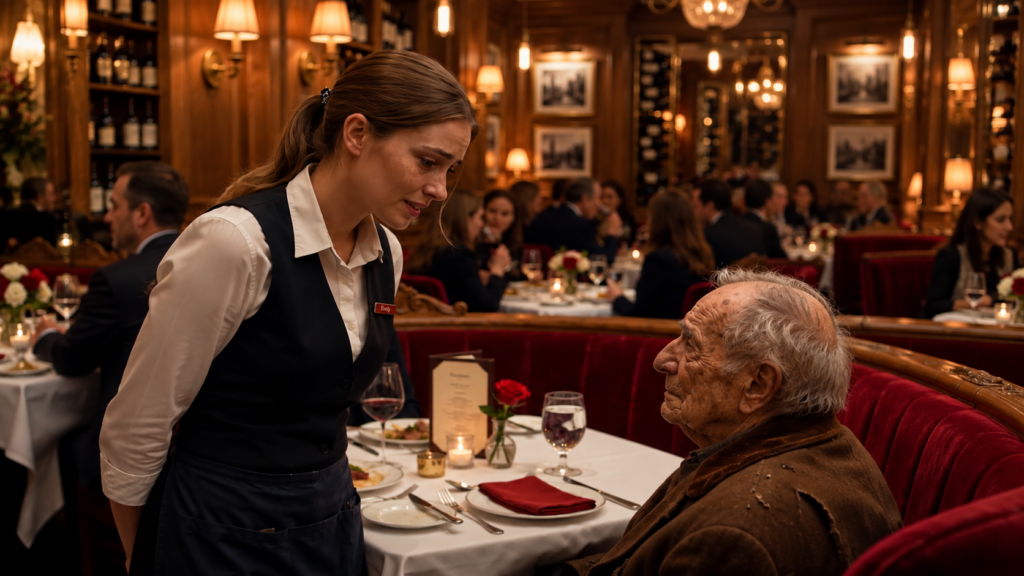
Emily Carter knew that a restaurant could tell a lie without speaking a word.
The tall windows of the Halcyon Room reflected the city like a promise that nothing ugly could happen behind the glass.
There were white roses on every table and linen napkins folded into the shape of small sailing boats.
A pianist played softly beneath a painted ceiling, while the dining room captain moved between tables as if he were conducting an orchestra.
Outside, on the other side of the revolving door, a delivery cyclist was arguing with a taxi driver in the rain.
Inside, a woman complained because the candle beside her plate was one shade darker than the other candles.
Emily had been working at the Halcyon Room for fourteen months, long enough to know which complaints required an apology and which required a manager to invent an apology grand enough to impress the complaining customer.
She was twenty-four, recently promoted from breakfast service, and still trying to earn enough money to pay for the dental work her mother had postponed for years.
The promotion had come with longer hours, shorter breaks, and a uniform made of fabric that showed every drop of water.
At six forty-five, her supervisor, Conrad Pike, caught her checking the time beside the service station.
“Your section is not a clock-watching section,” he said.
“I was checking when table eighteen’s soufflé should come out,” Emily replied.
“Then keep your eyes on the kitchen door and your opinions to yourself.”
Conrad had a narrow face and an ability to smile without appearing pleased.
He had spent the afternoon preparing for a private event that would begin after the public dinner service.
A discreet notice at the entrance said the restaurant would close early for a special presentation called The Thirteenth Course.
Nobody on the service team knew what the presentation involved, although the kitchen had received crates of theatrical equipment and a pair of strangers had been measuring the distance between the tables.
The staff had been told to work as usual and avoid asking questions.
At seven ten, a man in a brown coat entered through the revolving door.
He was thin and tall, with a soft gray scarf wrapped twice around his neck.
Rainwater darkened the shoulders of his coat, and his right hand trembled when he took off his hat.
The hostess looked from the man to the reservations screen.
“Do you have a booking?” she asked.
“No,” he replied. “I was hoping for a quiet corner and something warm.”
“Our dinner service begins at ninety dollars per person before beverages.”
“I see.”
The man looked down at his polished but worn shoes.
“Could I sit for a moment while I decide?”
The hostess glanced at Conrad.
Conrad lifted two fingers, an impatient gesture that meant she could seat him where he would not be seen from the entrance.
She led him to table twenty-two, a small table beside a decorative screen.
Emily noticed him because he thanked the hostess as if she had done him an extraordinary favor.











