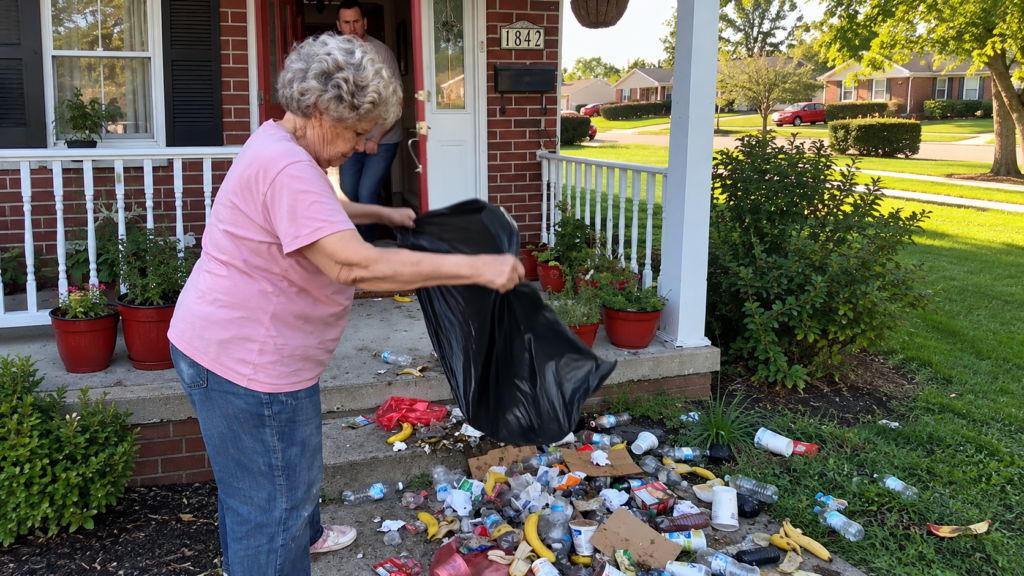
The first can struck Daniel Reed’s front door at eleven seventeen on Saturday morning.
Daniel heard the metallic rattle from his kitchen and assumed the wind had knocked something off the porch.
Then a glass jar shattered, and somebody shouted his name.
He opened the door to find Carol Mercer standing on his welcome mat with an empty black garbage bag in her fist.
At sixty-seven, Carol had the stubborn posture of a woman who had spent her life getting answers from people who preferred to walk away.
She was also standing in the middle of enough household rubbish to fill a wheelbarrow.
Coffee grounds stained his steps, wet newspaper stuck to the railing, and several empty cans rolled toward the flowerbeds.
Daniel stared at the mess.
“What are you doing?”
Carol folded her arms.
“You know exactly why I’m here.”
“This is my house, Carol, and you need to pick that up.”
“Perhaps you should think about what you threw away first.”
Her gaze darted toward a torn grocery bag near his left shoe.
Daniel followed it and saw a shipping label bearing his name.
He recognized the box immediately.
The label had arrived on Wednesday, attached to the replacement parts for a battered mechanical compass he had found in the storage shed at the recreation center.
He had discarded the box and its broken contents on Thursday night.
The locked trash bin stood behind a six-foot gate at the back of his house.
Carol could not have recovered the package without entering the property.
Daniel pulled the soggy cardboard from the pile.
Inside lay a small brass compass case,
its glass face cracked and its needle missing.
“You went through my garbage.”
Carol stopped pretending not to be frightened.
“Did you open it before you threw it away?”
“I saw a broken compass.”
“And the paper ring?”
“What paper ring?”
She pushed past a spilled carton and knelt beside the box.
Daniel noticed that her hands were trembling.
“Tell me where you found this,” she demanded.
“In a storage crate at the old recreation center.”
“You weren’t supposed to take anything from that crate.”
“I was hired to clear it before the renovation.”
“Then you should have listened when I told you to keep out of that room.”
Daniel remembered three weeks of complaints about his truck, his visitors, and a ladder leaning against his shed.
He had considered Carol merely unpleasant.
Now he realized she had been trying to keep him away from something specific.
He stepped between her and the open door.
“Get off my porch.”
Carol rose carefully.
“A boy is going to walk into the north maze at three o’clock, and that compass is the only thing that tells us which exit isn’t real.”
Daniel blinked.
The annual Lantern Maze opened that afternoon at Briarfield Park.
Its temporary corridors were built from wooden panels and painted canvas, and teams raced to solve puzzles before sundown.
Daniel had volunteered to repair its mechanical puzzle stations after an organizer complained about broken equipment.
“It’s a game,” he said.
“That’s what they want you to think.”
“Who?”
Carol glanced toward the street, where a white delivery van had slowed beside the curb.
The driver watched them through a dark windshield.
“Get the box inside,” she said.
Daniel did not move.
“Tell me what is happening.”
The van rolled onward.
Carol lowered her voice.
“If you hand that compass to the wrong person, nobody gets to explain afterward.”
“You destroyed my porch to deliver a warning?”
“I destroyed your porch because you wouldn’t open the door when I knocked.”
“You never knocked.”
“I did yesterday, twice.”
Daniel remembered the headphones he had worn while repairing a wooden maze gate.
It was possible she had tried.
It did not excuse the mess.
“You’re going to help clean every bit of this,” he said.
Carol’s expression hardened again.
“After we find the missing needle.”
He held up the broken compass.
“Why does a missing needle matter?”
“Because this was never a compass,” Carol said.
“It was a key.”











