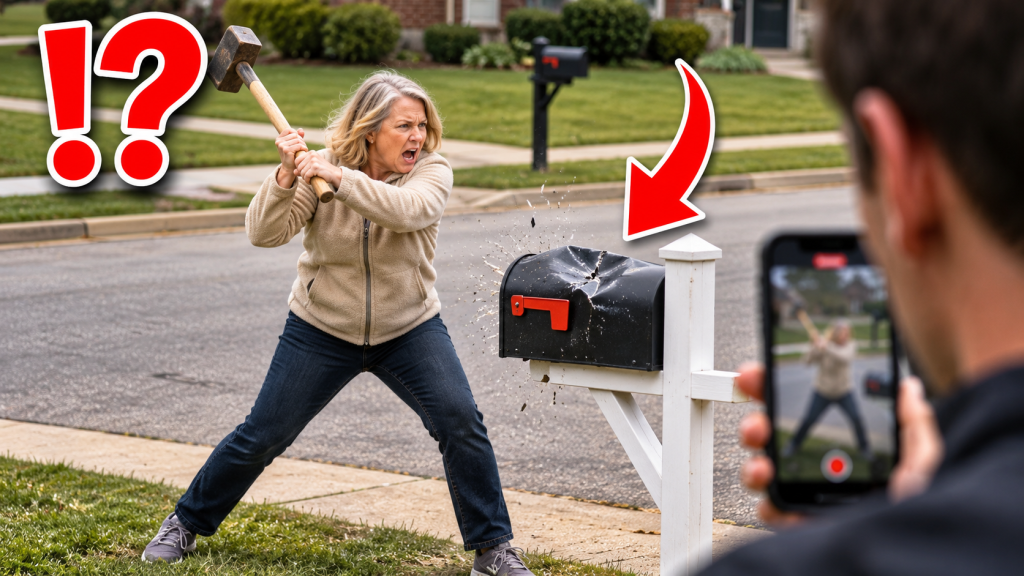
The first thing Daniel Brooks noticed was not the axe.
It was the expression on Patricia Reynolds’s face as she crossed the street toward his driveway.
She was smiling the way people smile when they have already decided that nobody can stop them.
The morning had begun quietly in a Charlotte neighborhood called Briar Glen, where the lawns were carefully trimmed and the houses stood far enough apart to suggest privacy without providing much of it.
Daniel had been carrying two mugs of coffee toward the stairs when he heard Patricia’s voice outside.
He recognized that voice immediately.
For nine months, Patricia had treated his dark blue mailbox as though it were a personal insult.
She had photographed it from the sidewalk, measured its distance from the curb, and sent him three letters demanding that he replace it with a black model approved by her informal neighborhood committee.
Daniel had read the actual community covenants twice.
He had even paid a local attorney to review them after Patricia threatened a lien.
There was no rule about mailbox color.
There was no committee authorized to approve replacements.
Most importantly, Patricia was not the president of the homeowners association, although she liked to introduce herself that way.
She had been removed from that position the previous spring after a disputed election.
Some neighbors knew that detail, but few were willing to say it aloud.
Patricia’s husband owned a landscaping company that maintained several nearby developments, and her brother had friends at the management office that collected the neighborhood’s dues.
She understood how to make ordinary people worry about expensive problems.
Daniel had spent thirty-four years repairing industrial refrigeration systems, and he knew the difference between a real safety hazard and somebody else’s desire to win an argument.
He had survived layoffs, back surgery, and the long illness that took his wife, Rebecca.
He was not afraid of a painted mailbox.
But he had learned that a person determined to manufacture trouble could turn a harmless object into a very costly fight.
That morning, Patricia came carrying an axe with a bright orange handle.
Daniel put down the mugs and walked outside before she reached the curb.
He tried to keep his voice steady.
He told her that she was standing on his property and needed to leave.
Patricia raised the axe and announced that she was going to teach him what happened when residents ignored her rules.
Daniel told her to put it down.
She struck the post instead.
The first blow split the wood near the base, and the metal box lurched sideways.
The second blow knocked the box free and scattered envelopes across the wet concrete.
Daniel heard a neighbor gasp from across the street.
He took one step forward, then stopped when Patricia turned toward him with the axe still in her hands.
He was angry enough to feel it in his throat, but he would not give her an excuse to claim he had threatened her.
Patricia laughed at his restraint.
She told him that his retirement check would never cover the legal fees she could create.











