Daniel Reed heard the first crack while he was cutting an apple at his kitchen counter.
The noise came from behind the house, where the old galvanized tank stood between his vegetable beds and the alley fence.
He put down the knife and heard a second impact.
By the time he reached the back steps, his sixty-five-year-old neighbor Carol Mercer had raised a baseball bat for another swing.
The bat struck the tank with a hollow metallic boom.
A dent opened beside its lower seam, and a bright thread of water began running down the wall.
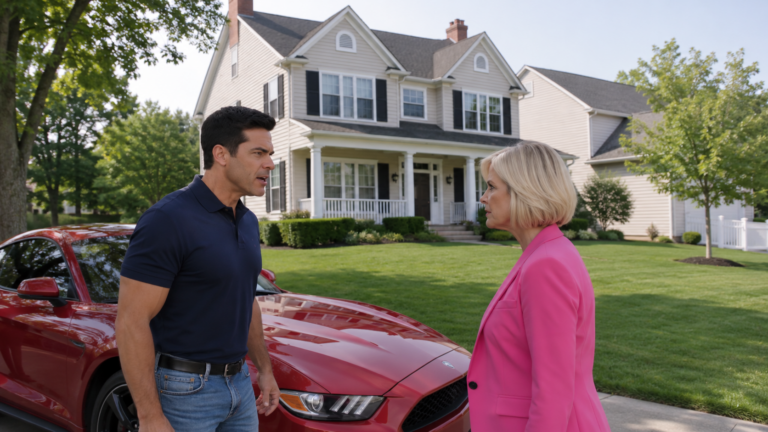
“Carol, what are you doing?” Daniel shouted.
She turned toward him with the bat resting across her shoulder.
“This ugly thing should have been removed months ago.”
“It is on my property.”
“Not according to me.
”
Her smile was almost cheerful.
Daniel saw a new crack widening below the latest dent, and he raised his phone.
“You are destroying something you do not own.”
Carol looked directly into the camera.
“Go ahead and film it.”
She hit the tank again.
Daniel kept his distance, although every instinct told him to pull the bat from her hands.
“You really should stop,” he said.
“Or what?”
Two patrol cars turned onto Willow Creek Drive before he could answer.
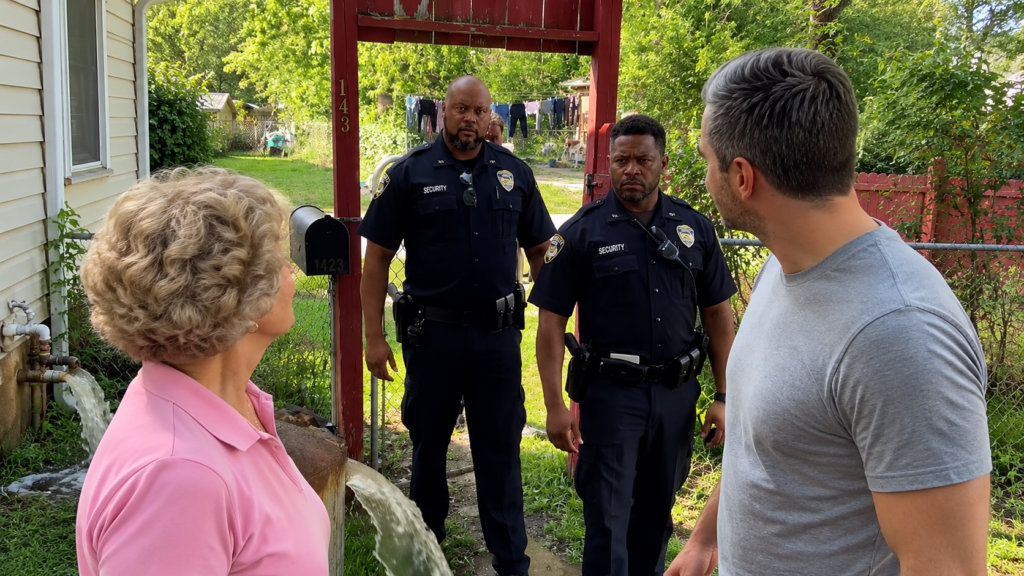
Carol lowered the bat slightly, then recovered her smile as the officers came through Daniel’s side gate.
One officer was broad-shouldered and young, with the name Alvarez on his badge.
The other was a woman in her forties who carried a small notebook instead of approaching the broken tank immediately.
“Who did this?” Alvarez asked.
Carol pointed at Daniel.
“He has been illegally storing water and flooding my property.”
“She struck the tank four times,” Daniel said.
“I recorded the last two.”
Carol folded her arms.
“Good, then they will see I warned him.”
The woman officer, Sergeant Keene, asked both neighbors to step away from the wet patch.
She noticed that the water was draining toward a gravel channel instead of Carol’s fence.
“Are you saying the tank was leaking before today?” she asked.
“For months,” Carol replied.
“Then why is the ground beneath the older pipe dry?”
Carol opened her mouth, but Alvarez had already moved around to the far side of the cylinder.
He brushed dirt from a small brass plate bolted near the base.
“Is this the original identification tag?” he asked Daniel.
“My grandfather installed it decades ago.”
Alvarez read the stamped numbers again, then turned to Keene.
“This is county equipment.”
Carol interrupted immediately.
“It is a rusty yard tank.”
“It is listed on the county emergency-water plan,” Alvarez said.
“The service line branches to other houses.”
Daniel looked at the pipe disappearing under a bed of rosemary.
He knew his grandfather had maintained a backup supply during winter outages, but he had never understood that anyone else could draw from it.
“Which houses?” he asked.
“We are checking that now,” Keene answered.
Alvarez raised a second question before Carol could leave.
“Mrs. Mercer, why did you tell dispatch you had never seen this tank before when your signature appears on the notice describing it?”
The smile disappeared so quickly that Daniel almost missed the change.
For the first time, Carol looked less angry than trapped.
“That was years ago,” she said.
“It was eleven months ago,” Alvarez replied.
“And the form was an acknowledgment of shared emergency access.”
Carol glanced at the broken seam, then at the officers’ radios.
“I want a lawyer,” she said.
“You can ask for one,” Keene replied.
“For now, put the bat down.”
Daniel watched the bat land in the grass beside the water he had once used to irrigate his grandfather’s peach tree.
It occurred to him that Carol had aimed every blow at the same narrow part of the tank.
That looked less like uncontrolled anger than a person carrying out instructions.