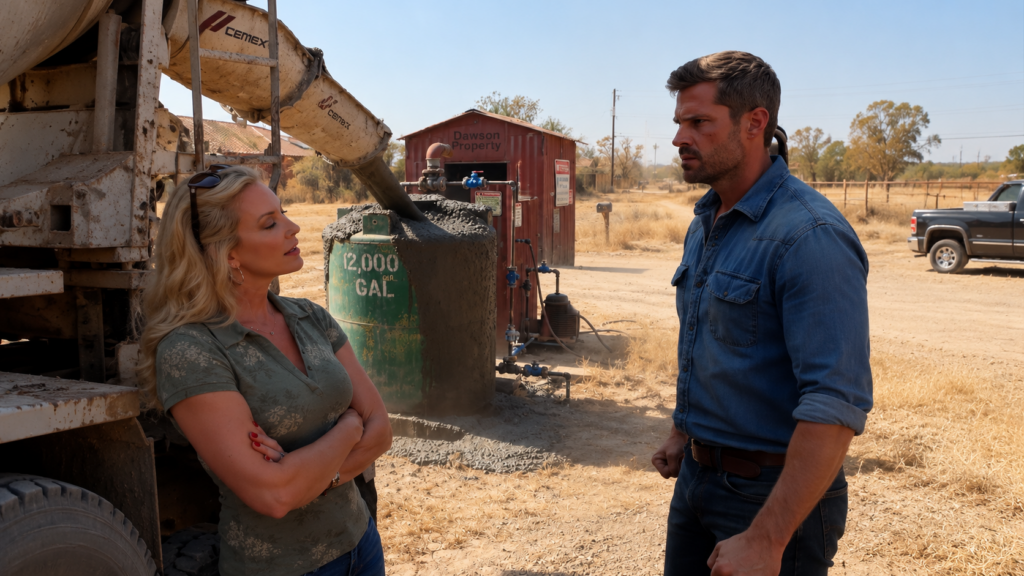
Cole Dawson was sixty miles west of Lone Star Bluffs when his phone began vibrating against the dashboard.
He ignored the first call because he was passing a tractor on a narrow two lane road.
He answered the second when his cousin Tessa appeared on the screen.
Tessa did not bother saying hello.
“Debbie has a concrete truck in your yard.”
Cole almost laughed because the sentence made no sense.
“What kind of truck?”
“A mixer, Cole.”
He heard shouting behind her.
“They’re pouring into Grandpa Hank’s tank.”
Cole pulled onto the shoulder so hard the truck bounced into gravel.
“Stop them.”
“I’ve tried.”
“Get the driver on the phone.”
“Debbie told him she owns the house next door and the neighborhood voted to remove the eyesore.”
“There was no vote.
”
“I know that.”
Something metallic boomed through Tessa’s phone.
Then a man shouted that the hopper was empty.
Cole stared at the morning sky above his windshield.
For an instant he could see his grandfather climbing the ladder of the old green tank with a wrench in his teeth.
Hank had built the system in 1971, when the nearest municipal line stopped four miles short of the Dawson place.
The tank held twelve thousand gallons when full, although the neighborhood usually kept it well below capacity.
It fed the common irrigation network, the clubhouse’s sprinkler reserve, the swimming pool’s replenishment line, and a limited backup supply that served 142 homes.
In 2003, Cole’s father had sold surrounding acreage to a developer under an agreement that preserved access to the original well and storage system.
The people buying the finished houses rarely heard about the agreement.
Their monthly association statements called it the western utility reserve.
Cole knew the names of every valve.
Debbie Prescott knew only that she could see an ugly green cylinder beyond the fence of her immaculate patio.
“Get everyone away from the tank,” Cole told Tessa.
“Why?”
“Because concrete weighs more than water, and somebody just put several tons where they don’t belong.”
He turned around and drove home faster than he had driven in years.
By the time the rooftops of Lone Star Bluffs appeared beyond the cedar trees, four cubic yards of quick-set concrete had disappeared into the tank.
The concrete driver was washing his chute into a plastic tub.
Two workers stood beside their truck looking deeply uncomfortable.
Debbie Prescott leaned against a silver sport utility vehicle, her sunglasses reflecting the sun.
She wore a spotless white blouse and held a paper cup of iced coffee.
Cole stopped so abruptly that gravel sprayed across his own driveway.
He ran toward the tank without closing his door.
A gray ridge of concrete had risen around the access opening.
The pump housing beneath it was buried almost to the electrical junction box.
Water seeped through a lower seam where pressure pushed against an old gasket.
The sight made Cole physically sick.
“Who authorized this?” he demanded.
Debbie lifted her chin.
“I did.”
“You ordered people to destroy a working water system.”
“I ordered an abandoned tank filled so it wouldn’t collapse on my children someday.”
“You don’t have children.”
“That isn’t the point.”
Cole turned toward the driver.
“Did you check who owned the property?”
The driver rubbed his forehead.
“She presented a removal request from the neighborhood association.”
“A request isn’t ownership.”
“It had an association letterhead.”
Debbie gave a little shrug.
“Everybody agreed the thing needed to go.”
Cole pointed toward a row of houses downhill.
The sprinklers were coughing in short bursts.
At the curb, an automatic irrigation valve opened and released a thin brown ribbon before falling silent.
“That tank feeds your house, Debbie.”
She looked amused.
“My water comes from the city.”
“Most days.”
He crouched beside the ruined pump house.
“When the city pressure drops during drought restrictions, this system keeps the western reserve alive.”
Tessa arrived carrying a binder full of worn plastic sleeves.
“The agreement is here,” she said.
Debbie did not look at it.
“You can show me twenty binders.”
Cole stood.
“One hundred forty-two homes are tied to this system.”
The first homeowner appeared at the fence with a dead hose in his hand.
“Cole, are you shutting us off for maintenance?”
Another neighbor shouted that the clubhouse fire panel was reporting low reserve pressure.
A third asked why the pool pumps had stopped.
Debbie’s smile finally failed.
“They have city water,” she whispered.
Cole watched the service meter flicker and die.
“You just destroyed the one thing that protected them when city water isn’t enough.”











