The first thing I saw was the little brass flag lying in our driveway.
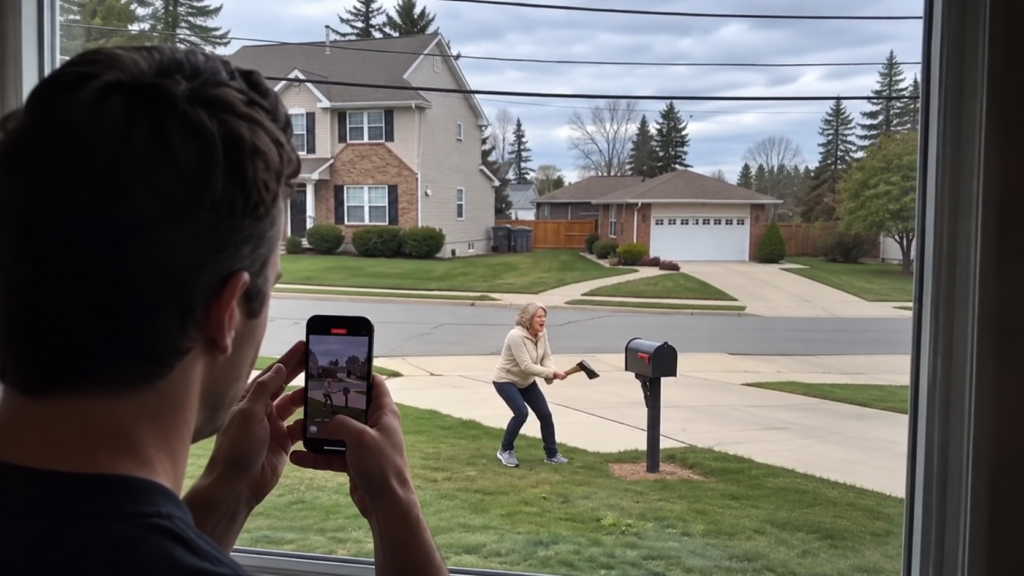
The second was the splintered door of our mailbox, hanging by one screw from the blue post beside the road.
The third was a woman across the street watching me through the lace curtains of her kitchen window.
It was six fifteen on a Friday morning, and the whole neighborhood still smelled of rain.
My daughter Sophie was supposed to leave for school in forty minutes.
She had an audition that afternoon and had spent the previous night rehearsing until the dog next door began howling along with her violin.
I had promised to make pancakes, but I stood beside the broken mailbox holding a torn piece of white envelope in my hand.
The envelope had been addressed to me.
Mr. Evan Mercer, 18 Wren Lane, Bellhaven, Massachusetts.
The return address was the Sutton Youth Arts Trust in Boston.
Sophie had applied to the trust in January.
It funded an intensive summer program for young musicians whose families could not cover tuition.
She had practiced for that audition through winter evenings when the radiators rattled and our grocery budget barely lasted the week.
The letter was gone.
Not misplaced in the box or blowing against the hedge, but gone as completely as if somebody had known what to take.
There were three advertising flyers in the wet grass and a utility bill folded beneath a stone.
Only the white envelope had been opened.
I looked at the Caldwell house.
Celeste Caldwell stepped away from her window before I could raise a hand.
That was the first time I suspected her.
It would be another seventeen days before I understood why she had been awake before sunrise.
I worked as a night-shift mechanic at a regional bus depot, which meant I missed a good deal of the life happening in daylight.
Sophie was sixteen, tall for her age, and stubborn enough to practice a difficult measure forty times before allowing herself dinner.
Her mother, Hannah, had died from a sudden illness when Sophie was eight.
The violin had been Hannah’s, an old instrument with a faint pale scratch near the bridge and a sound larger than our cramped living room.
I understood very little about music, but I understood the expression on my daughter’s face when she played.
It was the one time grief stopped demanding an explanation.
Celeste Caldwell had lived opposite us for nine years.
She chaired the Bellhaven Youth Music Council, organized charity concerts, and wore expensive scarves that always matched the flowers on her porch.