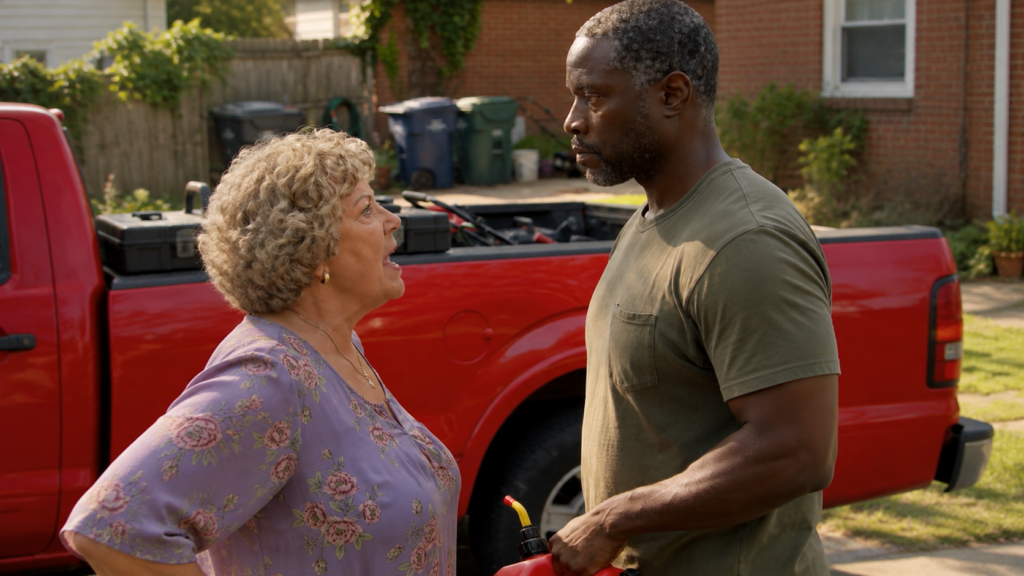
Marcus Hill heard the scrape of sensible shoes before he saw Carol Mercer.
He was standing in the narrow driveway beside his pickup, settling the cap on a red gasoline can.
The late October sunlight caught the white county inventory sticker beside the handle.
A second can sat empty in a locked compartment behind the cab.
His scheduled equipment test began in less than an hour.
Carol crossed the property line without greeting him.
She was sixty-five, dressed in a gray cardigan and dark slacks, and wearing the irritated expression she brought to every dispute on Briarwood Lane.
“Give me some of that gas,” she said.
Marcus placed the can on the ground.
“The station is three blocks away.”
“I didn’t ask where the station was.”
“And I didn’t offer you my gasoline.
”
Carol studied the can as though the conversation had somehow failed to follow the rules she expected.
“You have plenty.”
“I paid for what I needed.”
“I’m your neighbor, Marcus.”
“I know where you live.”
“Then you can spare a few gallons.”
He had spent fourteen years responding to people on their worst days, and he knew that an argument could become dangerous simply because one participant wanted an audience.
He bent to lift the can.
“No, Carol.”
Her mouth hardened.
“You always make everything difficult.”
“I said no. Go home.”
She moved between him and his truck.
“You think you can talk to me like that?”
“I’m talking to you like someone demanding my property.”
Carol glanced down the street, where two landscaping crews were loading equipment.
One worker noticed them and slowed.
“That gasoline came out of a public station,” Carol announced loudly.
“Every station is open to the public. That doesn’t make the fuel free.”
“You people always have a smart answer.”
Marcus looked at her for a moment.
He was tired of deciding whether a phrase was meant exactly the way it sounded.
He was more tired of knowing that his neighbors rarely had to make that calculation.
“Please leave my driveway,” he said.
Carol stepped backward, but she wasn’t finished.
“You’ll regret being so arrogant.”
Marcus waited until she crossed the sidewalk before he carried the can into his garage.
A silver sedan passed slowly, its driver looking toward Carol’s porch.
Marcus did not recognize the driver.
He pulled out his phone and checked the time.
The county training coordinator had sent three messages since breakfast.
At three o’clock, the first group of volunteer teams would arrive for a test of the new emergency fuel distribution system.
Marcus needed to be there before the staging lanes opened.
He had barely reached the kitchen when glass exploded outside.
He turned so quickly that the phone struck the counter.
Through the back window he saw Carol beside his truck, both hands wrapped around a tire iron.
A thousand fragments of passenger glass glittered across the driveway.
Marcus ran through the side door.
“Did you just smash my window?”
Carol didn’t bother hiding the tool.
“Maybe now you’ll learn some respect.”
He stopped several yards away.
He could hear the landscapers shouting for one another to back up.
“Put that down.”
“Don’t order me around.”
Marcus raised his phone and began recording.
“You damaged my vehicle because I wouldn’t give you gasoline.”
“Go ahead. Call whoever you want.”
She smiled at the lens, apparently satisfied that the world would finally see how unreasonable he was.
Marcus called emergency dispatch and described the damage, the tire iron, and the absence of any immediate injury.
He did not announce his title.
He requested that the responding officers approach carefully because Carol still had the tool.
She laid it on the grass only when she heard the first siren.
Two patrol cars arrived within minutes.
Officer Tessa Boone directed Carol toward the sidewalk while her partner inspected the passenger door.
Carol began talking before anybody asked her a question.
“He threatened me over gasoline.”
Marcus held out his phone.
“I recorded the damage.”
“He doesn’t respect neighborhood property rights,” Carol insisted.
Boone watched the video without commenting.
Then she examined the smashed glass and asked Carol where the tire iron had come from.
Carol pointed toward her garage.
“That’s not the point.”
“It’s one of the points,” Boone said.
A dark county sedan turned into the driveway.
County administrator Julian Pierce stepped out carrying a slim black case.
He saw the broken window and stopped.
“Chief Hill, we’ve been trying to reach you.”
Carol stared at Marcus.
Boone looked from one man to the other.
“Chief?”
Marcus retrieved the identification wallet from his pocket.
The badge carried his photograph, his name, and the title County Fire Chief.
Carol’s expression collapsed.
“I didn’t know who he was,” she whispered.
“That shouldn’t have mattered,” Marcus said.
Julian approached the truck and noticed the county seal on the registration sleeve visible inside the windshield.
“Did she know this vehicle belongs to the county?”
Marcus looked at Carol again.
“She knew it wasn’t hers.”
Neither officer spoke for several seconds.
Then Boone asked Carol to turn around and place her hands where they could be seen.
The click of handcuffs was quiet compared with the sound of the glass breaking.
Marcus watched Carol’s face as she realized that the confrontation had moved beyond a neighborhood argument.
He felt no satisfaction.
His first concern was the unlocked space where his test equipment had been stored.
His second was the strange silver sedan that had passed before the attack.
And his third arrived when Julian opened his phone and showed him a text from the county operations center.
“We have a problem at the readiness site,” Julian said.
“What kind of problem?”
“The first twelve fuel vouchers have already been redeemed.”
Marcus looked at the time.
“The test hasn’t started.”
“I know.”
Julian lowered the phone.
“And every one of those vouchers was issued under your name.”











