By the time Harper Lane pushed open her sliding glass door, a green soda bottle was spinning slowly in the deep end of her swimming pool.
A flattened cereal carton had caught against the ladder. Two disposable coffee cups floated beside a toy sailboat her nephew had forgotten on Sunday. Across the turquoise surface stretched a widening island of wrappers, crushed containers, paper napkins, and a remarkable number of orange plastic ribbons.
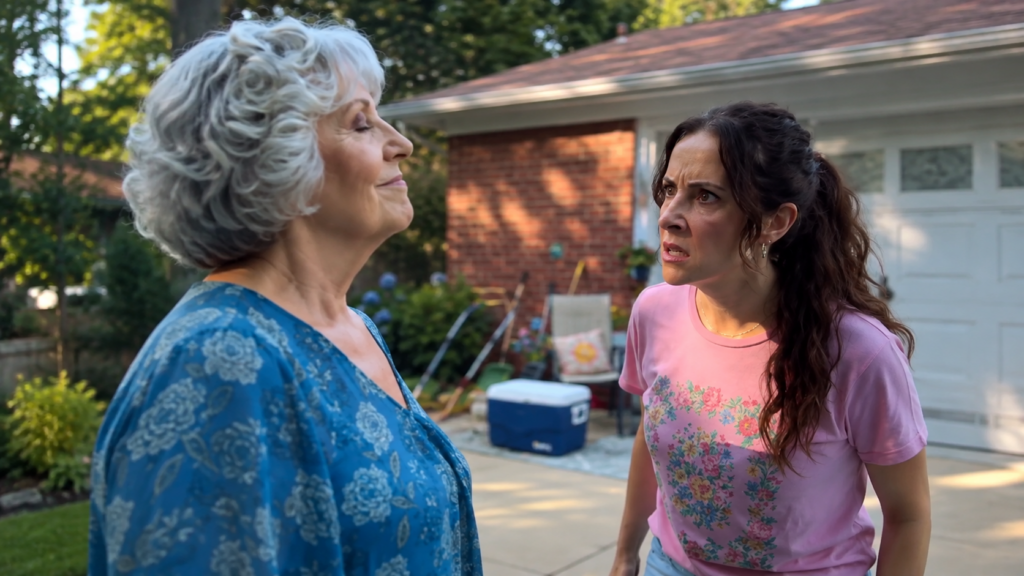
At the center of the mess stood seventy-three-year-old Odessa Pike, still clutching the empty black garbage bag.
Harper stopped on the patio. She was thirty-four, barefoot, wearing paint-stained jeans and the gray sweatshirt she used when she worked from home. She had been calculating the price of repairing the roof over her small theater workshop. She had not expected to discover an elderly neighbor emptying refuse into the pool.
‘What are you doing?’ Harper demanded.
Odessa turned. The woman wore a yellow cardigan despite the warm morning, and her silver hair had been fastened with two mismatched clips. She did not appear surprised to see Harper. That, somehow, made the sight worse.
‘You finally came out,’ Odessa said.
‘You put garbage in my pool.’
‘Yes.’
‘Why?’
‘I needed you to look at what was left.’
Harper stared at her. ‘Then knock on my door like a normal person.’
‘I did. Yesterday. And Monday. You told me through the doorbell that you couldn’t speak to me.’
‘Because you were shouting about a children’s show I don’t run anymore.’
Odessa tightened her grip on the bag. ‘You promised those children they would get their stage.’
Harper walked past a broken umbrella stand and stopped three steps from the older woman. ‘That does not give you the right to do this.’
‘I know.’
‘You know?’
‘I know it is wrong.’ Odessa’s voice shook, but she did not lower her gaze. ‘I came here wanting you angry enough to listen. You could have called the police. I expected that. I also expected you to ask why I brought precisely this bag.’
Harper looked toward the pool again. The ribbons were not random. Tiny paper stars had been glued to them. Between floating bottles she spotted a cardboard sun with a smiling face, its yellow rays bent backward. There was a painted whale with one eye missing. Several objects were pieces of scenery.
‘Where did you get these?’
‘From the bins behind Bellweather Hall.’
A painful pressure gathered beneath Harper’s ribs. Bellweather Hall had been the town’s neglected rehearsal building until Harper leased it for an after-school shadow-theater project called Open Door. For fourteen months, children aged nine to sixteen had built paper cities, enormous puppets, and moving backdrops under her supervision. Three weeks earlier, Harper had closed the program.











