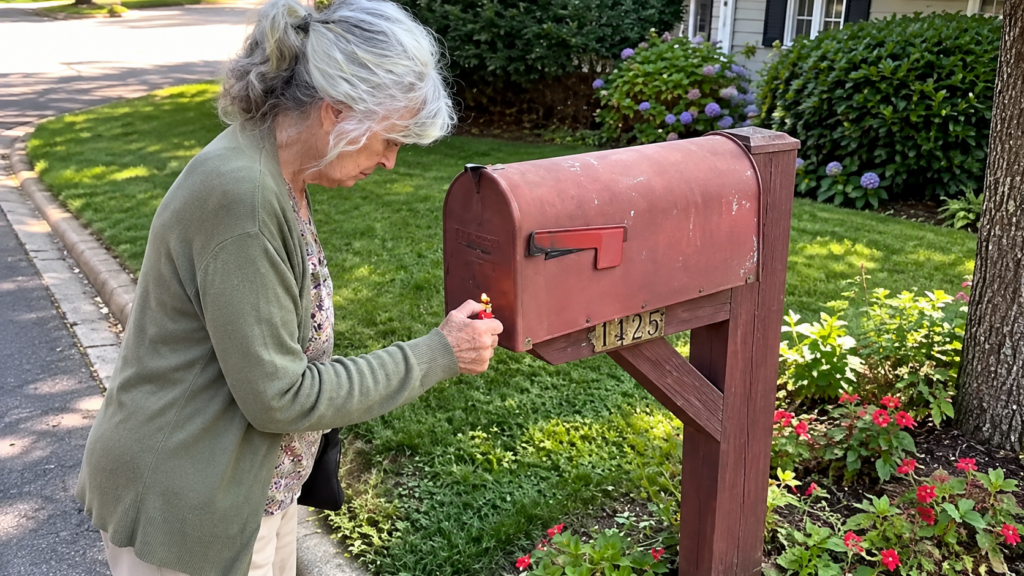
The first thing Owen Mercer noticed was the smell. He had been carrying a basket of laundry through his front hall when a bitter ribbon of smoke slipped beneath the weather stripping. At first he blamed someone burning leaves, although that was prohibited in Briar Glen. Then orange light jumped against the frosted glass beside his front door.
He put down the basket and looked out. His red mailbox was burning.
Five minutes earlier, Mrs. Etta Voss had walked along the edge of his lawn wearing her dark green raincoat despite the warm afternoon. She had paused at the roadside, bent toward the mailbox, and gone away with the deliberate pace of somebody refusing to hurry. Owen had seen only the last few seconds through his kitchen window. He had thought she was leaving another complaint about his garden. Etta had opinions about everything on Juniper Lane, from the height of hedges to which color of bunting belonged at neighborhood celebrations.
Now flame boiled through the mailbox door. Owen stepped onto the porch and felt the heat even from the path. He started toward the curb before a sharp metallic pop stopped him. The mailbox lurched sideways on its post. He backed away and shouted for his neighbor to call the fire department. A passing cyclist had already stopped and pulled out a phone.
The grass around the post smoked. A piece of something pale rested just beyond the scorched patch, and Owen nearly stepped on it as he retreated. It was a rectangle of heavy card, curled at one corner but untouched by flame. A thin brushstroke of cobalt blue crossed it, followed by a narrow line of yellow.
Owen knew those colors. He had spent the last month mixing them for a restoration project at Briar Glen’s old public bathhouse, which had been converted into a community arts hall. The project was supposed to culminate on Saturday, only three days away, in a celebration called the Wall of First Hands. Dozens of artists were repainting a twenty-foot mural that had disappeared behind generations of advertising boards. The colors on the card were the colors of the mural’s original sky.
He crouched without touching the card. Someone had written two words across the visible corner: FOR OWEN.
A voice behind him said, “Don’t go closer.”
It was Mara Solis, his neighbor from two doors down. She had arrived carrying a garden hose, but she kept the nozzle pointed away from the fire, waiting for firefighters who knew what had started it. Owen told her what he had seen of Etta. Mara looked toward the neat white house at the bend, where every curtain was closed.
“That woman chairs the arts committee,” Mara said. “Why would she burn your mail?”











