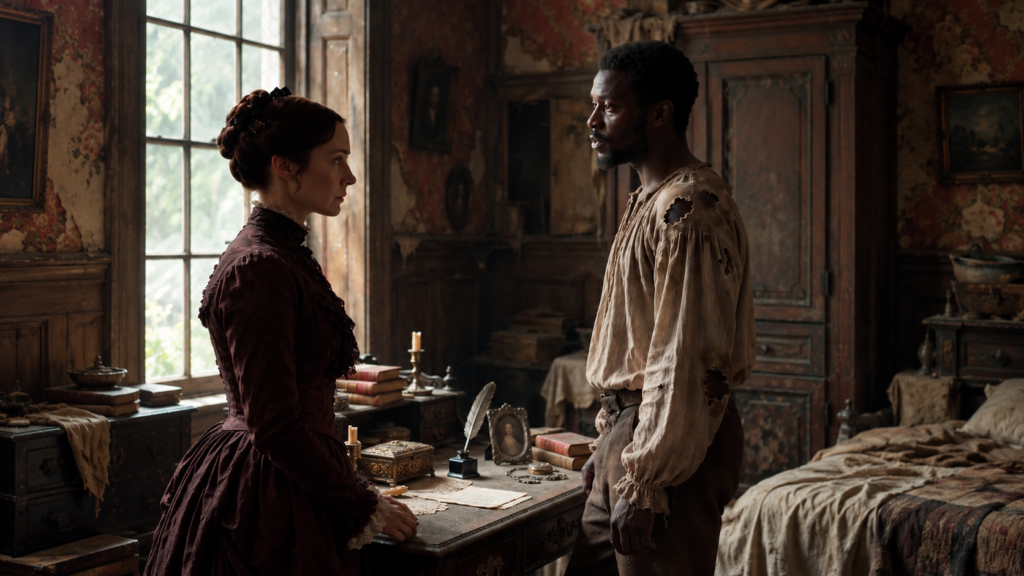
The auctioneer laughed when only one bidder raised her hand for Elijah Carter.
“Thirty-five dollars for him?”
The crowd joined in, delighted to discover somebody apparently foolish enough to purchase a man who walked with a pronounced limp.
Elijah stood beneath the Georgia sun with his shoulders still and his hands open.
His shirt had torn along one shoulder during the morning inspection.
A bruise marked the side of his neck where a guard had pulled him away from another buyer.
Catherine Whitmore raised her hand again.
“I said thirty-five dollars.”
The auctioneer gave her a theatrical bow.
“Then the gentleman is yours, Miss Whitmore.”
The word gentleman drew another round of laughter.
Elijah looked at Catherine as the auctioneer closed his ledger.
For an instant, she saw recognition in his expression,
followed by something more difficult to understand.
He looked relieved, but he did not look grateful.
Catherine was twenty-four, newly returned to the plantation her father had left her, and thoroughly unprepared to manage the ugliness of owning it.
Her father had died three weeks earlier after a fever that had emptied the great house of sympathy long before it emptied his lungs of breath.
His younger brother, Ambrose Whitmore, had already begun speaking of debts and necessity.
He had insisted that the household’s enslaved workers should be sold in groups as soon as a judge confirmed the estate accounts.
Catherine had refused to authorize a sale, but Ambrose controlled the papers and the creditors knew his name.
At the auction, she had seen Elijah turned around like a damaged horse and refused by men who wanted cheap strength.
Then he had met her eyes.
She had purchased him before considering how easily a moment of indignation could become another form of power over a stranger.
On the ride home, Elijah sat opposite her in a wagon beside three sacks of flour.
He watched the road more closely than the house approaching at its end.
Catherine finally asked whether his leg needed a physician.
“It needs a night without somebody deciding how fast I ought to walk,” he answered.
She flushed and looked away.
A mile later, he asked whether her mother’s writing desk remained in the house.
Catherine turned toward him so sharply that the wagon jolted beneath them.
“My mother died when I was twelve.”
“I remember.”
“How could you know about her desk?”
“Mrs. Whitmore asked me to find you.”
Catherine stared at him.
“My mother has been dead twelve years.”
“I know how long she has been gone.”
His voice carried no invitation to pity him.
“Your father told you she died after a sudden illness, and he told the households that she had gone away to relatives before she died.”
“He told me she was buried here.”
“He told you many things.”
Catherine opened her mouth, but the wagon arrived at the iron gate before she could frame a useful question.
Ambrose stood on the steps with a walking stick and an expression of injured ownership.
He looked at Elijah and grimaced.
“You paid money for that fellow?”
Catherine climbed down.
“I did.”
“He will cost more to feed than he can produce.”
Elijah did not lower his head.
Catherine was suddenly aware of every worker listening from the porch, yard, and kitchen doorway.
“He can have food and somewhere to rest tonight,” she said.
Ambrose smiled without warmth.
“You always did mistake a household for a charity.”
He walked inside before she could answer.
Elijah waited until the front door closed.
“Do not tell him what I asked about the desk.”
“Why?”
“Because he is listening to everything else.”
Catherine followed his glance toward an upstairs window.
A curtain moved, and the house appeared to close its eyes.











