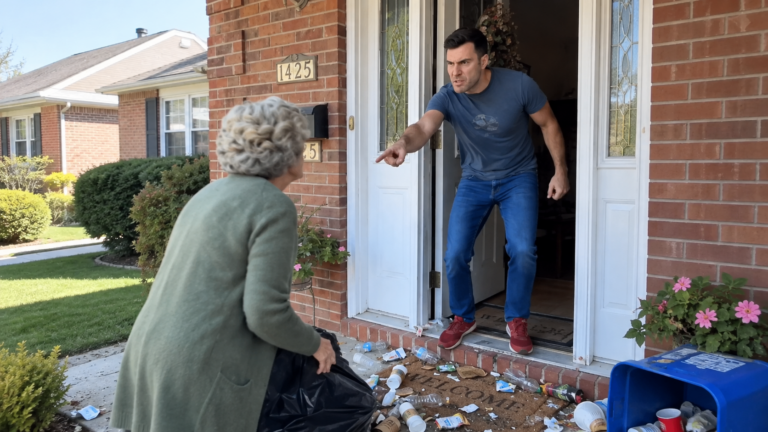
“My brother is alive,” Edith said before Mara could ask. “His name is Raymond. He’s seventy-six and lives in a residence near Grayfield. They called me with a recording of him begging for help.”
Keene sat quietly beside the doorway. Mara placed the soup on the counter.
“What did they say would happen?” she asked.
“They said Raymond had signed up for something. Some program for older people to meet people, go on trips. Then they said he’d broken an agreement and owed them money. I told them he couldn’t have. He doesn’t have money like that. So they played the recording.”
Edith pulled a crumpled tissue from her sleeve. “He was saying, ‘Edie, please.’ He calls me Edie. Nobody else does anymore.”
“Have you spoken to him directly?”
Edith shook her head. “They said he wasn’t allowed calls until I settled what he owed. I paid what I had. Then they wanted me to do one more thing.”
“Dump the garbage,” Mara said.
“Yes. They gave me the bag at six. Told me to walk into your backyard at seven fourteen, stand beneath the camera, and make sure the contents were visible. They said if I did it, Raymond could come home. If I refused, they’d move him somewhere I couldn’t find him.”
Mara tried to imagine crossing a familiar yard carrying that bag, knowing the person who lived there would see the humiliation. The cruelty seemed almost deliberate in its unnecessary details. Someone had required Edith to make herself hated, to become a distraction so conspicuous that Mara would overlook the intruder at the other end of the property.
“Why didn’t you tell me afterward?” Mara asked.
“They said they’d know if I talked. A man parked outside until midnight. He did the same thing on Sunday. I couldn’t think. I kept picturing Raymond on a bus somewhere, frightened and alone.”
Keene explained that officers had contacted the residence. Raymond was physically safe. He had made a distressed phone call after being told his sister was in trouble. The recording had been taken from that call, cut short, and played to Edith without the explanation. He had not been held captive. The deception was real, and so was Edith’s fear.
Edith covered her face. For a long moment Mara heard nothing but the kitchen clock. Then the old woman reached for the napkin Mara had set beside the soup and wiped her eyes.
“He asked me not to send money to anyone,” she whispered. “Last Christmas. I told him he was being silly. And then I did exactly what he warned me about.”
Mara did not tell Edith that everything was all right. The pool required cleaning, the dogs had been frightened, and a stranger had entered the house while a child slept upstairs. An apology could not reverse any of that. But Edith had been used, and her brother’s wellbeing had become part of the danger. Mara found herself angry in a direction she could act upon.