“I’m not going to pretend what happened was harmless,” she said. “But I want you to tell Keene every time that sedan came, every number that called, and every word they made you say. That’s how we make it harder for them to do this again.”
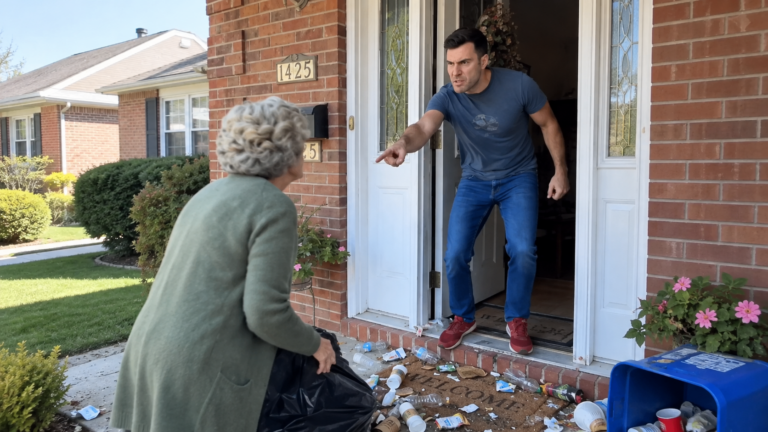
Edith nodded. Then she reached into the pocket of her cardigan and produced a small orange plastic clip. “They attached this to the garbage bag. It had a number on it. The man told me to remove it before I went through the gate. I put it in my pocket instead. I thought somebody might need to know who gave me the bag.”
Keene leaned forward. On the clip, beneath a strip of dried black adhesive, was a hand-lettered inventory code: PAV-12. Mara recognized the first three letters from the advertising for the Mercer Exhibition Pavilion. The thing that had made Edith’s act visible was also the thing the men had wanted her to throw away.
8. The Empty Stage
At the Pavilion that afternoon, work crews were arranging folding chairs beneath banners that read LISTEN TO WHAT MATTERS. The main stage had three painted doors and a large screen for projecting each participant’s question. An overhead rig supported velvet curtains, but there were no dogs, no kennels, and no visible signs that the show had been hastily rearranged. Victor Senn stood at the center aisle directing workers as if nothing outside the building concerned him.
Mara and Nisha entered with two volunteers from Second Mile, both wearing ordinary clothes. They had purchased general admission passes, and Nisha had already informed the rescue’s attorney of their plans. Officer Keene knew they were visiting but had warned them not to provoke a confrontation. Her department was pursuing the trespass and threats; the animal ownership dispute was being handled separately.
Victor spotted Mara halfway down the aisle. He was a handsome man in his late forties, with neatly combed hair and a voice trained to sound calm in a crowded room. He approached with a smile that did not extend to his eyes.
“Ms. Ellison, I believe,” he said. “You’ve had quite an eventful weekend.”
“You sent somebody into my garage.”
“That allegation is being discussed through the proper channels. I don’t conduct disputes in the foyer.”
“Then why did you invite the public here to watch dogs you don’t have?”
His smile thinned. “We have a program planned. People are looking forward to it. I hope you’ll respect that.”
Nisha stepped between them. “The animals are not yours to use, Victor.”
“That remains to be established.”
He turned away before they could reply and signaled a worker to move the painted doors farther apart. Mara noticed a cluster of visitors waiting to speak to him. One elderly man held his hat against his chest. Another woman clutched a photograph so tightly its edges had folded. None looked like a wealthy collector searching for an amusing night out. They looked like people who needed a question answered.