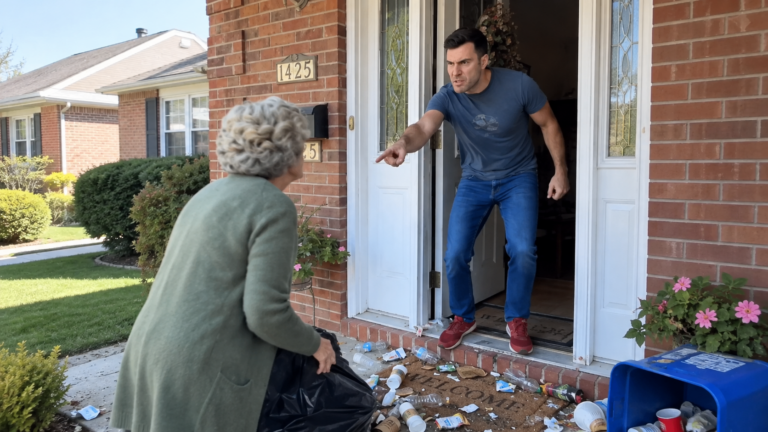
One of them pointed at Mara. Victor shook his head, then gestured toward the exit. Whatever he intended next, he had stopped treating her as someone who would quietly return home.
9. The Dog That Wouldn’t Leave
By the time Mara returned home, Frances had placed a chair in front of the sunroom and Owen was sitting beside it with a paperback novel he had not turned a page of in twenty minutes. June paced behind the glass. Patch pressed his nose against the door and whined when he saw Mara. Cedar emerged from beneath the table, careful with his crooked leg, and stood close enough for Mara to feel his breath against her wrist.
“A truck drove around the block twice,” Frances said. “Dark gray, no writing on it. I called the officer and kept the dogs inside.”
Mara checked the gate and found the replacement lock intact. She also noticed a new pair of footprints beside the rear fence, where the grass had been crushed beneath heavy soles. Keene returned her call and asked for photographs. The officer was already coordinating extra patrols with neighboring districts. Mara could hear traffic in the background as she spoke.
“They’re going to come back,” Mara said.
“They may,” Keene replied. “But our response can’t rely on guessing where. You should take the dogs somewhere else tonight. A licensed boarding facility, if Nisha can arrange it.”
Nisha had been working on that possibility all day. Several kennels refused the group because the animals were the subject of a dispute. Two had no space, and another couldn’t accommodate a dog with Cedar’s injured leg. At last she found a veterinary hospital with seven empty recovery runs, but it could not take them until the next morning. Mara needed to protect the animals for one more night.
They moved bedding into the interior dining room, which had no exterior door. Mara borrowed temporary barriers from the rescue volunteers and made separate resting spaces so no dog would become anxious in the unfamiliar arrangement. Frances remained for dinner, and Owen helped attach bright labels to each collar. He insisted on writing every name by hand.
“If they put them in a truck again,” he said, “somebody should know who they are.”
Mara knelt beside him. “If someone tries, the adults will deal with it. Your job is to be safe.”
“I can help by telling you things.”
“You can. And you already have.”
He held Cedar’s blue collar in both hands. “But the man outside my window had a picture of him. What if he knows where we take them next?”
Mara could not dismiss the possibility. Nisha’s group was small, and Victor appeared to know where dogs were moving even before the volunteers did. Someone who had worked at the Annex might still be close enough to the rescue to hear their plans. Instead of sending the hospital’s name through the usual volunteer messaging group, Nisha arranged the transfer directly with its director. Only Mara, Nisha, and the attending veterinarian would know the destination.