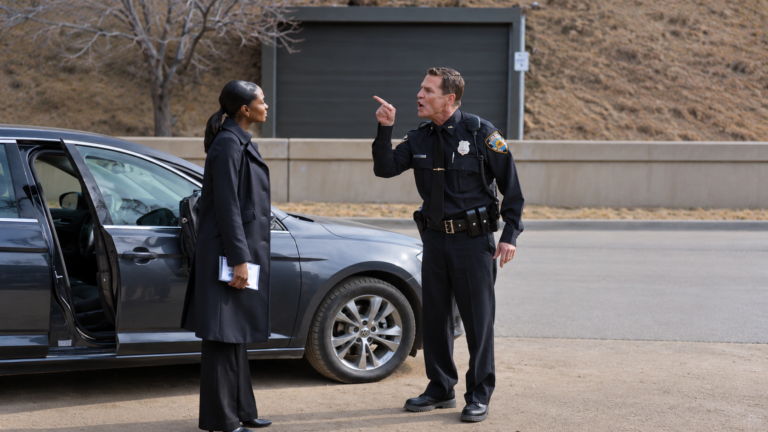
Three weeks after the traffic stop, Richard Sterling entered the federal courthouse wearing a dark blue suit.
His attorney, Martin Kessler, walked beside him carrying a narrow trial case.
Reporters gathered near the security checkpoint.
Sterling answered only one question.
“I have served this community honorably,” he said.
“The facts will show that.”
Inside the courtroom, he sat at the defense table and watched the other parties assemble.
Marisol Vega sat beside Luis in the first row.
Ellen Moss took a seat near her attorney.
Deputy Quinn stood quietly along the back wall.
Hayes arrived without his uniform and sat several rows away from his former supervisor.
Sterling noticed him and turned back toward the front.
A court officer asked everyone to rise as the judge entered.
Judge Elaine Whitaker reviewed the matters set for argument.
The hearing concerned preservation, preliminary relief, and the scope of evidence regarding an alleged pattern of unlawful stops and impounds.
Then the side doors opened again.
Young Jenkins entered carrying a leather briefcase marked with a gold federal seal.
She wore a charcoal suit and moved with the controlled pace of someone who had spent years inside courtrooms.
David Roth rose to greet her.
Kessler stopped speaking in the middle of a sentence.
Sterling looked from Young to the gold seal and back again.
He recognized the woman who had picked her clothes out of the mud.
He did not recognize the woman whose title appeared on the court’s witness schedule.
The clerk confirmed her identity.
Judge Whitaker addressed her as Director Jenkins when explaining the conditions for her later testimony.
Sterling leaned toward his lawyer.
“Director of what?” he whispered.
Kessler’s jaw tightened.
“Federal oversight,” he answered.
Sterling stared at the back of Young’s chair.
She did not turn to look at him.
The chief seemed to expect a confrontation or a triumphant smile.
Instead, Young opened a notebook and waited for the court to begin.
Kessler requested a brief recess to review the witness schedule.
Judge Whitaker allowed five minutes.
When the lawyers moved toward the side conference room, Sterling followed them in disbelief.
“She was working undercover?” he demanded.
“The government says she was traveling for meetings,” Kessler replied.
“Then why wasn’t I told?”
His attorney looked at him sharply.
“Because she had no obligation to tell you her job before you treated her lawfully.”
Sterling began to speak, then stopped.
For the first time since the hearing began, he could not find an answer that improved his position.
The first testimony concerned the city’s obligation to maintain accurate impound records.
Priya described the method her team used to compare patrol reports, tow dispatches, and reimbursement claims.
She did not accuse every officer of wrongdoing.
She explained which records matched, which conflicted, and which remained missing.
Roth introduced a sample of entries showing vehicles classified as roadway hazards although the associated reports documented no dangerous condition.
Kessler questioned whether the sample represented the entire program.
“It does not,” Priya answered.
“It represents the discrepancies we can currently substantiate.”
Judge Whitaker asked for the total number of entries still under review.
Priya provided the count and distinguished confirmed inconsistencies from unresolved questions.
The judge nodded and wrote something down.
Ellen Moss then explained why she had questioned invoices and how Sterling had instructed her to stop delaying them.
Kessler suggested that she misunderstood a routine budget discussion.
Moss did not raise her voice.
“I asked him for supporting documentation,” she said.
“He told me to approve the claim without it.”
“Did he use those exact words?”
“He said the department did not need a clerk deciding which police actions counted.”
“That sounds like a division of responsibilities.”
Moss looked at the judge before answering.
“It would have been, if my job had not required verifying the supporting documents.”
Marisol testified next.
She described the stop, the working license light, the escalating storage charges, and the release form demanding that she waive complaints.
When she mentioned missing her children’s school events, her voice broke.
The judge gave her time to drink water.
“I am not asking this court to make me special,” Marisol said.
“I am asking why paying the bill never seemed to end the bill.”
Her words hung in the room.
Kessler questioned the timing of her husband’s inspection of the license light.
Marisol admitted that the inspection occurred after the stop.
She refused to claim she knew the light’s condition at every moment of the drive.
“What I know is that nobody explained why we had to lose our car for weeks,” she said.
The judge listened without interrupting.
Then Bradley Hayes was called.
Sterling watched him take the oath.
The rookie described Young’s stop and his own failure to intervene.
Roth asked whether Sterling had identified an offense before searching the rental sedan.
“Not in my hearing,” Hayes said.
“Did you observe resistance from the driver?”
“No.”
“Did the chief tell you to leave her luggage in the mud?”
“Yes.”
Kessler stood.
“Officer Hayes, are you testifying to protect your own position after being reassigned?”
Hayes looked toward the defense table.
“My position got worse after I spoke,” he answered.
“I am here because the facts did not change.”
Sterling looked away.