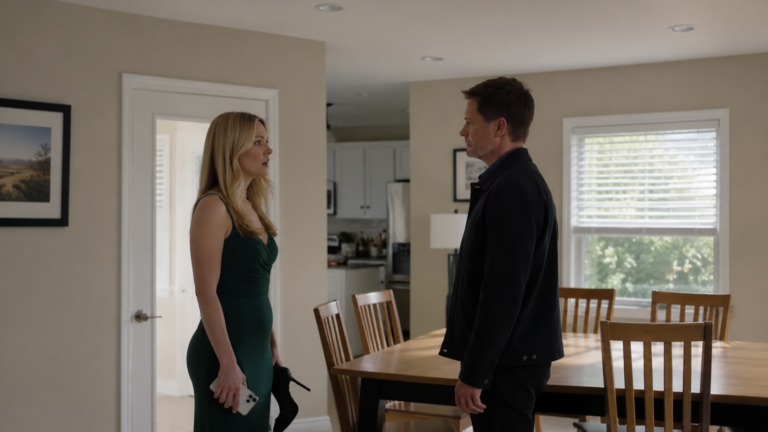
Sterling learned that Ellen Moss had agreed to an interview on the morning his department received another preservation notice.
The notice demanded records of who had approved changes to the road safety program.
He summoned Deputy Quinn to his office and closed the blinds.
“They’re digging through old accounting decisions,” he complained.
“The city has an obligation to produce the records,” Quinn said.
“You keep using that word.”
“Which word?”
“Obligation.”
She sat without being invited.
“I use it because it applies to both of us.”
Sterling paced behind his desk.
“I built this department when the council barely funded our radios.”
“You also signed the contracts.”
“Contracts that kept officers on the road.”
“Some of the extra shifts were used to tow cars that weren’t dangerous.”
He stopped walking.
“Are you accusing me?”
“I’m telling you what the records suggest.”
“You sound like the federal lawyers.”
Quinn took a slow breath.
“Last winter an officer asked whether a car needed towing when the driver was parked outside a tire shop.”
“I remember.”
“You instructed him to classify it as a corridor hazard.”
“It had a flat tire.”
“It was parked off the road.”
Sterling planted both hands on the desk.
“You weren’t there.”
“I was on the radio.”
For a moment he seemed to consider denying the conversation.
Instead, he changed direction.
“How many officers have been talking?”
“I won’t answer that.”
“I am still your chief.”
“And I am still responsible for accurate records.”
He stared at her with an expression she had never seen before.
Under the anger was something close to fear.
“People remember all the times I helped them,” he said.
“They remember when I found their kids and fixed their problems.”
“Those things don’t erase the other things.”
Quinn rose.
“The evidence custodian has protected the videos and dispatch records.”
“I didn’t authorize that.”
“The preservation order did.”
She left before he could threaten her job.
Outside, a patrol officer was waiting for a signature on a fuel request.
Quinn signed it and asked about his shift as though nothing unusual had happened.
She had spent years believing that loyalty meant keeping internal disputes private.
Now she understood that privacy had allowed ordinary mistakes to become established practice.
She was not proud of how long the change had taken.
Bradley Hayes attended his first interview with federal investigators on a cold Monday morning.
A union attorney sat beside him while Priya and a second investigator asked about the Route 9 stop.
Hayes described the moment Sterling approached Young’s rental sedan.
He confirmed that the driver’s papers were valid and that she had complied with instructions.
“Did you hear Chief Sterling identify a traffic violation?” Priya asked.
“No, ma’am.”
“Did you see any evidence of a weapon or illegal substance?”
“No.”
“What did the chief tell you about the stop before you arrived?”
Hayes rubbed his thumb along the edge of his notebook.
“He said the car looked out of place and that we were going to teach the driver respect.”
His attorney glanced at him but did not interrupt.
“Was there a safety reason to remove the luggage?”
“Not that I observed.”
“Why didn’t you help the driver retrieve it?”
Hayes swallowed.
“The chief ordered me not to.”
“Did you think the order was appropriate?”
“No.”
The answer came out quietly but without a qualification.
Priya paused before asking the next question.
“Did you do anything to stop him?”
“No.”
Hayes looked directly at her.
“I should have.”
He then described two unrelated traffic encounters in which he had been told to complete forms for vehicle removals he considered unnecessary.
His notebook contained dates, patrol numbers, and the names of other officers present.
The investigators warned him that notes alone would need corroboration.
He understood.
He was not asking them to make his testimony the entire case.
When the interview ended, his attorney asked for a break.
Hayes stepped into the hallway and leaned against the wall.
A vending machine hummed near the elevators.
He wanted to call his father and report that he had told the truth.
Instead, he looked at the ceiling and waited until he could breathe normally.
A young custodial worker pushed a cart past him.
She smiled and said good morning.
Hayes answered, then realized how ordinary the hallway appeared.
No music announced what he had done.
No supervisor emerged to congratulate him.
He had answered questions under oath, and now he would have to live with whatever followed.