CHAPTER TWO: AN EMPTY REASON
Young reached a roadside hotel eleven miles farther north and locked herself in a room overlooking a dark parking lot.
The hotel clerk offered a towel when she saw the wet clothes in Young’s arms.
Young accepted it gratefully.
Her hands shook when she tried to unfasten the buttons on her blouse.
She was angry, but the shaking also came from cold and exhaustion.
A woman could understand the law perfectly and still be frightened when armed authority treated her as an object.
She called her sister, Denise, before calling anyone connected to work.
“I got stopped,” she said.
“Are you safe?”
“I’m inside a hotel.”
“Did they hurt you?”
“They made sure I knew they could.”
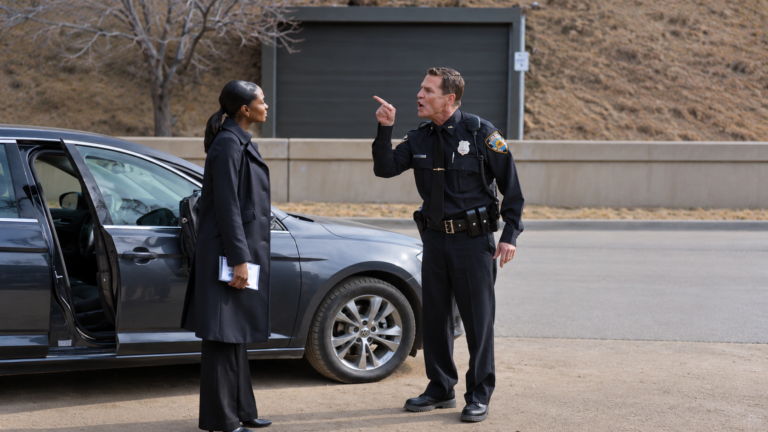
Denise listened as Young described the search, the mud,
and the rookie who had looked away.
“You should have told him who you are,” Denise said.
Young watched rain streak the glass.
“I was a driver on a public road.”
“That was all he needed to know.”
Her sister did not argue.
They both understood that a title could change the ending of a traffic stop without changing the wrongness of its beginning.
After the call, Young took photographs of her ruined clothing and wrote down the sequence of events while the details remained fresh.
She noted the first minute the blue lights appeared, the license plate numbers she had observed, the officers’ words, and the positions of their vehicles.
She remembered that Sterling had never issued a citation.
She remembered that he had never identified a traffic violation.
She remembered Hayes saying the rental registration was valid.
At midnight, Young opened an encrypted work laptop and considered a name in her contact list.
David Roth had spent months preparing a federal civil-rights case involving the Crestwood Police Department.
Young had recently taken charge of a separate oversight division, and her scheduled regional visit had been known to only a handful of staff.
She had traveled in an ordinary rental sedan because she did not want local officials building a ceremonial reception around an oversight trip.
She had not intended to become an incident in the case.
That distinction mattered.
She called Roth.
He answered on the third ring.
“Director Jenkins?”
“David, something happened tonight that you need to document.”
When she told him about Sterling, he was silent for several seconds.
“Did he recognize you?”
“No.”
“Did you identify your position?”
“No.”
“Then we have a problem and an opportunity, and I want to be careful about both.”
“The opportunity is not mine to exploit,” Young said.
“I will submit a complaint like anyone else.”
“I agree.”
Roth explained that the existing case concerned alleged unlawful seizures and a pattern of retaliatory policing.
The civil hearing scheduled in three weeks was intended to consider preservation orders and interim relief, not decide every charge or hand someone a sentence.
Young knew that already, but she appreciated his insistence on procedural boundaries.
She asked him to assign another supervisor to decisions involving her complaint.
“You should not be overseeing an investigation in which you are a material witness,” Roth said.
“I won’t.”
He promised a separate intake process and advised her not to contact Hayes or Sterling herself.
“Get some sleep,” he added.
“That is not likely,” she replied.
After the call, Young opened an ordinary hotel stationery pad and wrote a sentence for herself.
The chief did not know my title, and the others did not have titles to protect them.
She placed the pad inside her suitcase and stared at the ceiling until dawn.