The maple tree was ours.
I was not going to leave because a woman with a clipboard decided she wanted my property.
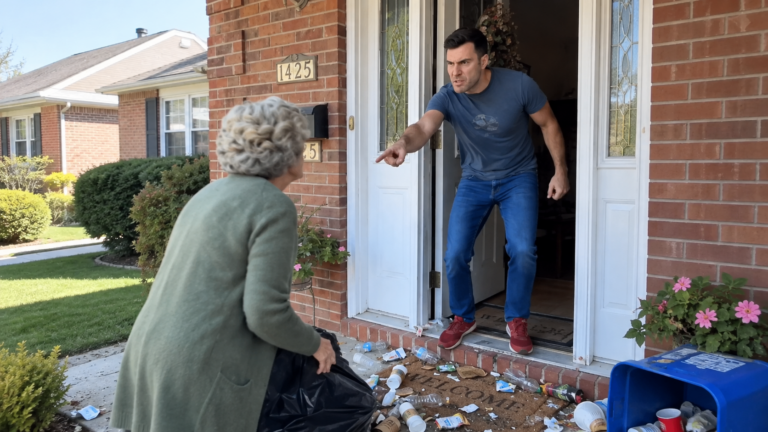
Karen moved into the large gray house next door in late autumn.
She arrived with two moving trucks and an expensive wreath on her front door.
She introduced herself as the new president of the Juniper Ridge Neighborhood Association before she told me her name.
I explained that our street was not part of a mandatory homeowners association.
She laughed as though I had misunderstood a simple rule.
She said the neighborhood needed leadership and uniform standards.
I said the neighborhood already had good neighbors.
Her smile tightened at the corners.
That was the first time I saw how she reacted to being contradicted.
Within a month, handwritten warnings appeared beneath windshield wipers.
Residents were told to remove flowerpots, repaint mailboxes, and stop parking work vehicles in their own driveways.
Karen called the warnings courtesy notices.
Most people ignored them until she began attaching invoices.
A retired schoolteacher named Mrs Alvarez received a demand for eight hundred dollars because her porch railing was green.
A young mechanic named Ben Lawson received a threat of towing because his pickup had a company logo.
The notices quoted rules that nobody remembered adopting.
I requested a copy of the association’s charter.
Karen sent me a glossy brochure about community excellence.
I asked again for the charter and the recorded covenants.
She stopped answering my emails.
I should have recognized that silence as the beginning of a campaign.
Instead, I assumed she would grow bored when she realized that invented rules had no legal force.
Then she saw my house through the eyes of a developer.
A narrow vacant lot behind our street connected to a proposed commercial road.
My backyard stood between that parcel and the only convenient access route.
The city planning office had rejected an earlier driveway proposal because it crossed residential property.
I learned about that proposal when a surveyor knocked on my door and asked whether I would consider selling an easement.
I said no.
The surveyor thanked me and left.
Karen arrived forty minutes later with a folder under her arm.
She said a cooperative homeowner could benefit from the coming improvements.
I told her that I was not interested in turning Evelyn’s garden into a service road.
Karen looked past me toward the maple tree.
She said sentimental attachments could become expensive.
I asked whether she was threatening me.