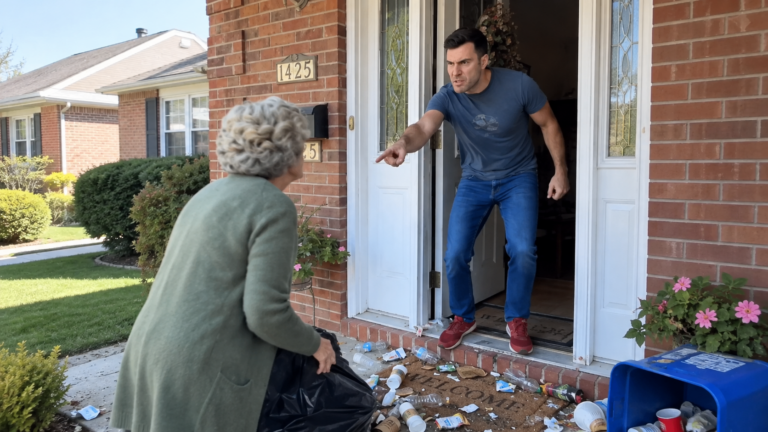
He asked whether I really believed his sister had planned everything.
I said I believed the evidence should be examined without either of us directing the outcome.
Russell stared at me for a moment.
Then he asked whether I knew how much money had already been committed.
I said that was a question for his investors.
He walked away without another word.
I stood beside the fence until he turned the corner.
The conversation left me uneasy because it sounded less like an argument than a warning about consequences he could no longer control.
THE BROTHER’S CHOICE
Russell requested a confidential meeting with the investigators through his attorney.
Mara learned about the meeting from a procedural filing in our civil case.
She warned me that cooperation did not necessarily mean he had become honest.
It could mean he had decided that Karen was the easier person to blame.
The first document produced afterward was a message Russell had sent to the consultant months earlier.
He had instructed the consultant to keep the land acquisition process separate from neighborhood enforcement activity.
The consultant had replied that Karen was handling community pressure.
Russell answered that he did not want operational details.
Mara said the wording might support competing interpretations.
Russell could argue that he wanted no part in improper activity.
The same wording could suggest that he understood improper activity was possible and preferred not to see it.
A later message narrowed the uncertainty.
Russell asked whether the owner on Juniper Lane had reacted yet.
The consultant answered that the owner had refused to engage.
Russell replied that delays were becoming expensive.
Mara said the sequence mattered more than any single sentence.
The messages established that Russell monitored the campaign while denying responsibility for its methods.
He had also approved payments to the observation vendor.
His attorney argued that the invoices had been mischaracterized by an employee.
The court ordered further production of internal approval records.
I felt no satisfaction when Mara told me.
Russell had treated my home as a financial obstacle.
Karen had treated my grief as a weakness she could exploit.
Neither explanation made the other harmless.
Sophie listened while I described the latest developments.
She asked whether people like Russell ever admitted what they had done.
I told her that admissions were less important than accountability.
She said that sounded like something I had learned at work.
I said it was something I had learned from her mother.