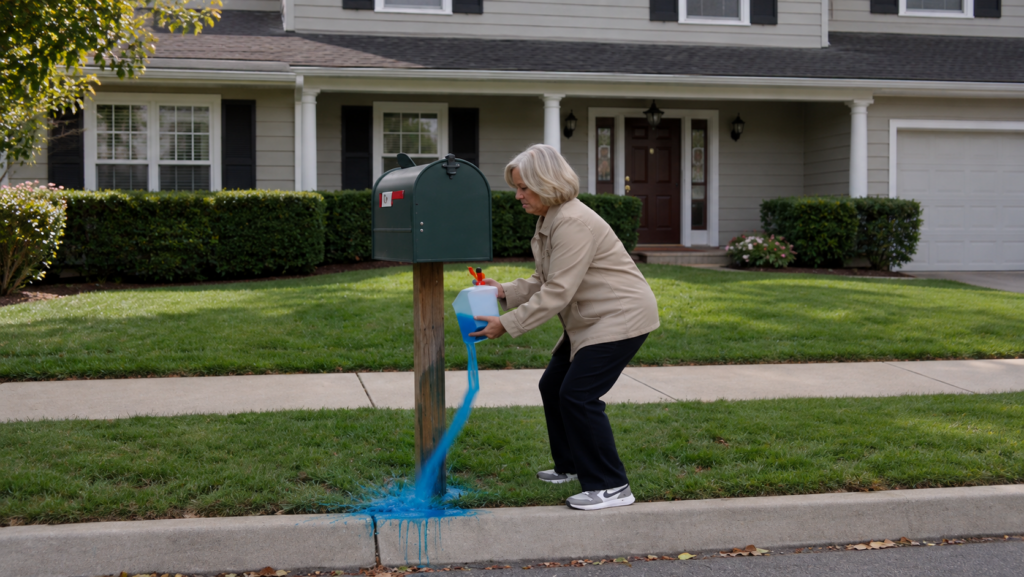
The first thing I noticed was that the woman carrying the container was wearing gardening gloves on a day when nobody was gardening.
The second thing I noticed was the man standing across the street with his phone raised before she reached my mailbox.
I had been standing behind my living room curtain, waiting for a delivery that had already been delayed twice.
My name is Claire Donnelly, and I had lived on Alder Court for eleven months.
That morning, I expected a letter from the state professional licensing board.
I did not expect my mailbox to catch fire.
The woman was Miriam Locke, who lived two houses east of mine.
The man filming her was Owen Rusk, my next-door neighbor and the person who had spent the previous month telling everyone that I was dangerous.
Miriam tipped the container toward the curb.
A pale liquid spread over the pavement, and she stepped away.
Fire suddenly raced along the wet trail and rose beside the wooden mailbox post.
I shouted through the window and reached for my phone.
Owen continued filming.
Miriam looked directly at his camera, and something about her expression stopped me from opening the front door.
She looked frightened, but not surprised.
The fire grew quickly enough that I called emergency services instead of running outside.
I told the dispatcher where the flames were and that someone was standing dangerously close to them.
Miriam set down the container and finally backed away.
Owen crossed the street, still recording, and called out that he had witnessed an attempted attack on the neighborhood.
He did not look at the fire until I shouted his name.
The dispatcher told me to remain inside while firefighters approached.
I watched Owen move his phone from Miriam to my front window.
He smiled when he saw me watching.
The smile disappeared when the first fire engine turned into Alder Court.
CHAPTER TWO: A LETTER THAT HAD NOT ARRIVED
The firefighters extinguished the flames before they reached my porch.
The mailbox had blackened along one side, and the post leaned toward the road.
A captain named Denise Hall asked whether anyone had been injured.
I said nobody had been hurt, but the person who started the fire was still standing beside her container.
Miriam sat on the curb with her hands folded between her knees.
Owen approached the captain before she could speak to Miriam.
He said he had recorded the entire crime and could provide the evidence immediately.
Captain Hall asked him to stand back until the scene was safe.
He objected loudly enough for two neighbors to come outside.
I recognized the performance because I had seen him deliver the same speech at our neighborhood meeting.
Owen liked an audience more than he liked answers.
An officer took statements from each of us separately.
When it was my turn, I explained that I had been waiting for a letter that could determine whether I would return to my profession.
The officer asked whether the envelope contained money or confidential information.
I said it contained a decision about my professional standing, but I had no reason to believe anyone else knew its contents.
That was not entirely true.
Owen knew enough to tell the neighbors that I had lost my license.
He did not know that I had appealed the decision or that the board was reconsidering the case.
I had never told him either detail.
When the officer asked about our disagreement, I told her that Owen had accused me of concealing an incident at my former workplace.
She asked what incident he meant.
I said a young patient had been injured during a transfer at the rehabilitation center where I worked.
I had reported a staffing failure, and the center had responded by accusing me of falsifying the transfer notes.
The accusation had suspended my occupational therapy license pending review.
Owen had learned about the suspension from a public notice and had treated it as proof that I was unfit to live beside his family.
He did not have children.
He simply preferred the phrase because it made his complaints sound less personal.
The officer listened without interrupting.
Then she asked whether I had seen Miriam ignite the liquid.
I said I had seen the fire erupt, but I had not seen the exact moment of ignition.
I refused to claim something I could not prove.
Across the street, Owen was telling another officer that his footage showed everything.
I wondered why a man who had been ready to record a fire had done nothing to prevent it.











