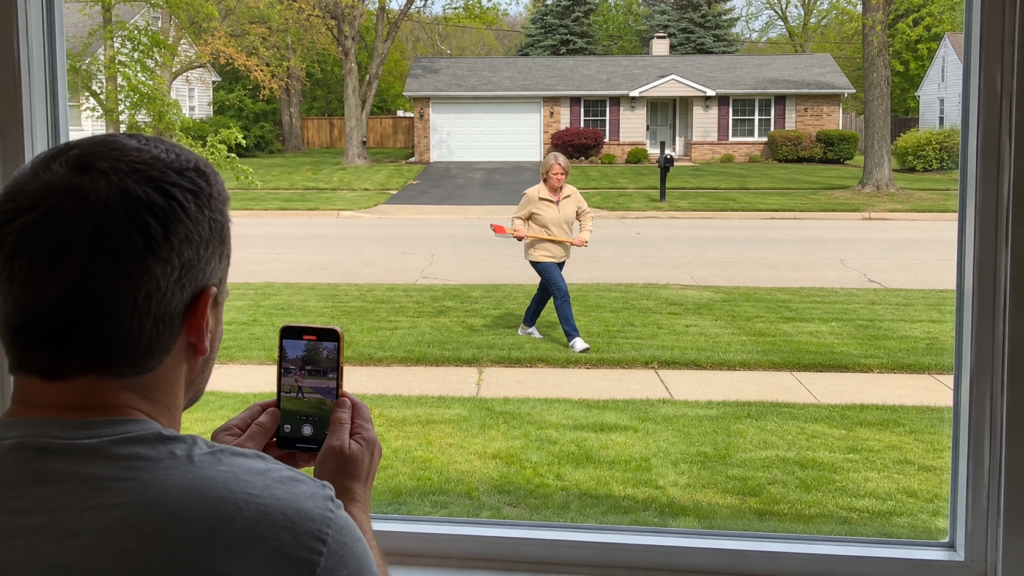
The first blow sounded like somebody dropping a skillet on concrete.
The second blow made our kitchen windows tremble.
I looked up from the lunch I was packing for my daughter and saw our neighbor standing beside the road with a carpenter’s hammer in her hand.
Judith Voss was sixty-one, wore expensive gardening gloves, and usually complained if a delivery truck left a tire mark on the grass.
That morning she was striking our mailbox as though it had personally betrayed her.
I ran out without putting on shoes.
“Judith, stop!”
She swung again before turning toward me.
The red flag snapped off and spun into the roadside ditch.
A white envelope fluttered from the broken door.
Judith lowered her hammer and placed one boot over it.
“Your box was falling apart,
” she said.
“I was helping you take it down.”
“With a hammer?”
“The post was rotten.”
“The post is steel.”
She glanced toward our front window, where my seventeen-year-old daughter, Sophie, stood watching.
Judith’s expression changed when she saw her.
“You should go inside, Sophie,” she called.
“You have practice tonight.”
I stepped between Judith and the mailbox.
“Move your foot.”
“What?”
“You’re standing on our mail.”
For an instant she looked ready to argue.
Then she picked up her foot and smiled too broadly.
The envelope lay in wet gravel, bent at one corner but still sealed.
Its return address read MIDLAND YOUTH ATHLETICS REVIEW COMMISSION.
Judith noticed me reading it.
“That looks like an old advertisement,” she said.
“You can throw it away.”
“I think I’ll open my own mail.
”
She tightened her fingers around the hammer.
“You don’t want to make a fuss over something that won’t matter after Saturday.”
Saturday was the regional gymnastics championship.
Sophie had trained for seven years to reach it.
Judith had coached her for four of those years.
I stared at the letter, then at the woman who had celebrated Sophie’s qualification with a cake shaped like a balance beam.
“What happens Saturday?” I asked.
“Your daughter gets the future she deserves,” Judith replied.
She walked away before I could ask why she sounded afraid.
CHAPTER TWO — WHAT THE ENVELOPE SAID
My husband, Daniel, reached home twenty minutes later and found me at the kitchen table beside the broken mailbox door.
Sophie sat across from me with her hands under her thighs.
The letter was short, but I had read it six times.
The commission had received reports concerning unsupervised training practices at the Marlowe Regional Gymnastics Center.
An independent panel would hold an expedited safeguarding conference on Friday morning.
Parents of named athletes had a right to attend, submit information, and request that affected athletes be excused from competition without penalty.
Sophie’s name appeared in a paragraph near the bottom.
The commission had attempted to reach us twice through the club and had now sent formal notification to our home.
“Why would they name Sophie?” Daniel asked.
Sophie stared at the envelope instead of answering.
“Did something happen at practice?” I asked.
“Everybody gets bruises,” she said.
“That’s not what I asked.”
“Judith said people are trying to ruin the team.”
Daniel pulled out a chair.
“Who are these people?”
“She said a parent complained because their kid didn’t make finals.”
“Which parent?”
“She wouldn’t say.”
Sophie’s voice flattened into the tone she used when rehearsing an answer before a difficult interview.
I knew that tone because I used to hear it when she explained missing homework in seventh grade.
Now I heard it every time I asked about practice.
“You can tell us what happened,” I said.
Sophie shook her head.
“If we start drama, they can remove our entire rotation.”
“Who told you that?”
“Judith.”
Daniel took the letter and read the section about confidential athlete interviews.
“It says nobody may punish you for speaking.”
Sophie laughed without smiling.
“That’s what grown-ups print on paper.”
Then she rose and asked whether she could still go to practice.
I told her we would decide after calling the commission.
She looked at me as though I had taken away the championship myself.
“Mom, you can’t do that.”
“I haven’t done anything yet.”
“You don’t understand what she’ll do.”
The room became quiet.
“What will Judith do?” Daniel asked.
Sophie covered her mouth with one hand.
“Forget it,” she whispered.
She went upstairs, leaving us with a letter that had arrived only because somebody at the post office refused to stop delivering it.











