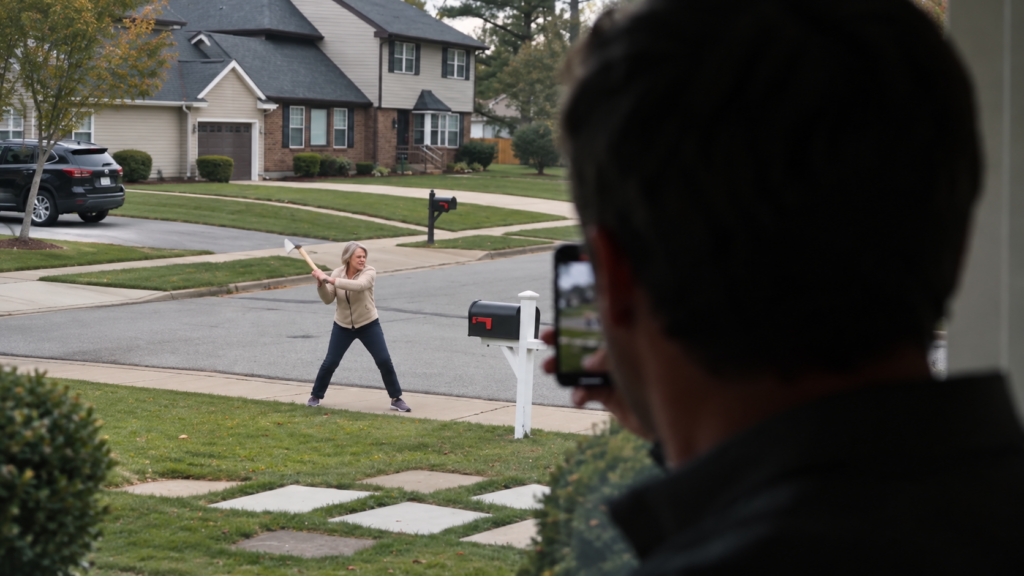
The first blow sounded like somebody dropping a toolbox onto the porch.
Evan Mercer looked up from the kitchen sink and waited for a second noise.
It came almost immediately, sharper and louder, followed by a metallic rattle that rolled across the quiet street.
Through the window, he saw his neighbor standing beside his mailbox with an axe raised over her shoulder.
Marla Voss was sixty-three, wore a yellow raincoat in clear weather, and had spent the last six months accusing Evan of ruining the neighborhood.
She swung again before he reached the front door.
The red metal box folded against its post, scattering grocery advertisements and a birthday card into the grass.
Evan started down the steps, but Marla pointed the axe toward him.
“Stay right there,” she shouted.
“That thing should never have been put back.”
Evan stopped because he had never seen her holding anything more threatening than a pruning shear.
“You could have asked me to move it,” he said.
Marla looked over his shoulder toward the second floor.
Her expression changed so abruptly that Evan turned to see what had frightened her.
The upstairs curtains were open, but nobody stood in the window.
When he faced the road again, Marla was dragging the axe toward her house.
She left the ruined mailbox lying in the ditch.
Evan did not chase her.
He had noticed something stranger than the violence.
Marla had attacked the box carefully, turning the blade sideways before the last two strikes as though she wanted to break the metal without cutting through the wooden post.
He bent down and found three shallow notches in the post, all at the same height.
Somebody had marked the wood before Marla arrived.
Chapter Two: The Upstairs Window
“Are you hurt?” a voice called from above him.
Evan looked up and saw fourteen-year-old Iris Chen leaning out of the upstairs guest-room window with her phone in both hands.
Iris was staying with Evan and his wife, Lila, while her mother recovered from surgery in another city.
She had been editing a school documentary about how ordinary people behaved when they believed nobody was watching.
“I filmed it,” Iris said.
“Every swing?” Evan asked.
“Every swing, but that’s not the important part.”
She disappeared from the window and met him at the staircase with the recording already playing.
The footage began before the attack, while Marla was still standing in the street.
A white delivery van had stopped at the corner, and a man in a green cap had stepped out to speak to her.
He pointed at the mailbox, then toward the upstairs window, before handing her the axe.
Evan recognized the man immediately.
His name was Nolan Price, and he ran the company that had been installing decorative street signs for the neighborhood association.
Nolan had told Evan two days earlier that the signs were being delayed because of a supplier problem.
On Iris’s screen, Nolan spoke to Marla for nearly a minute before driving away.
The phone’s microphone had captured only the final exchange.
“You promised nobody would be home,” Marla said.
“Then make sure they stay inside,” Nolan answered.
Evan replayed the sentence twice.
Iris lowered her phone.
“I think she wanted you to come outside,” she said.
Evan looked toward the empty road.
He had spent years teaching Iris to notice what happened around a dramatic event, rather than staring only at the drama itself.
Now she had noticed the part he missed.











