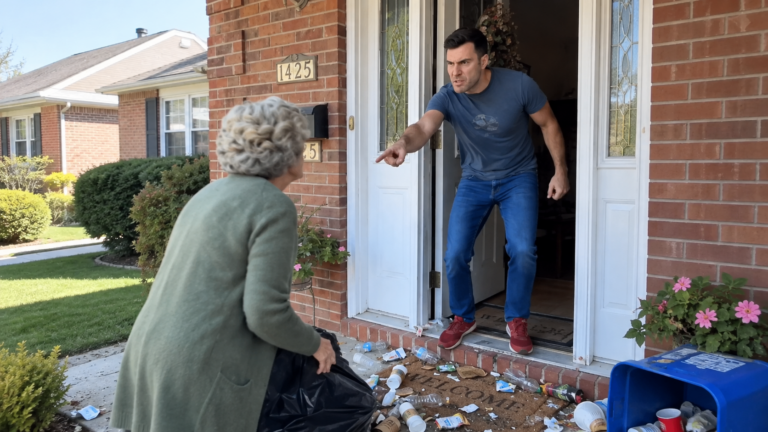
The first brick came through my kitchen window at six seventeen on a Tuesday morning.
I was standing beside the sink with a cup of coffee when the glass exploded across the counter.
The brick struck the cabinet behind me and knocked my daughter’s school photograph onto the floor.
I did not shout.
I did not chase the person running past the fence.
I reached for the phone that I had placed beside the coffee maker the night before.
The security feed showed a woman in a yellow raincoat turning toward the street.
Her hood concealed most of her face, but the white orthopedic shoe on her left foot was unmistakable.
My neighbor Karen Whitlock had worn that shoe since her ankle surgery in March.
She had also spent the previous evening telling the neighborhood that I was a violent man.
I watched the woman disappear behind the hedge and checked the clock on the recording.
Then I called the sheriff’s nonemergency line.
I knew Karen wanted me to run outside.
I knew she expected me to grab her by the arm and give her a photograph she could use against me.
She had already arranged for someone to be watching.
A dark sedan had been parked across the street since before dawn.
Its driver raised a phone toward my porch when the brick hit the window.
I stepped away from the broken glass and kept my hands visible.
The driver lowered his phone after several disappointed seconds.
I smiled without feeling any amusement.
Karen had prepared a trap.
Unfortunately for her, I had spent the last eleven days preparing one of my own.
My name is Nathan Mercer, and I was fifty eight years old that spring.
I had lived on Juniper Lane for almost two decades.
My wife Evelyn and I had bought the little cedar sided house when our daughter was still learning to walk.
We had planted a maple tree beside the driveway and measured its growth against the garage roof every summer.
Evelyn died four years before the brick came through my window.
Cancer took her slowly enough to make every ordinary day precious and quickly enough to leave me unprepared.
Our daughter Sophie had moved to Portland for work by then.
She called me most Sundays and worried whenever I sounded too cheerful.
I kept the house because every room contained something Evelyn had chosen.
The blue kitchen tiles were hers.
The crooked brass hook beside the back door was hers.