CHAPTER FIVE: THE PRICE OF A SIGNATURE
Saturday brought a hard gray rain and a letter from an organizer of the Fashion Exchange.
The organizer thanked Vivian for providing worker consent forms allowing the event to use personal stories from the studio’s training program.
A copy of the message had been sent to Hawa by mistake because someone had entered her address as the general contact.
Hawa forwarded it to me with four question marks.
I called her from our kitchen and read the sentence aloud.
“I didn’t sign any story agreement,” she said.
“I signed a paper when they first gave me fabric.”
“Did anyone tell you what the paper said?”
“They told me it confirmed I had received materials.”
At that moment, Rosa knocked on the back door with a suitcase rather than her usual envelope.
Inside were three unfinished garments and a padded dress form.
“The workshop supervisor told us to bring back everything by noon,” she said.
“He said the entire contract was being moved to another city.”
“Could that be normal scheduling?” Adrian asked.
“They’ve never cleared out the fitting room two days before a major show,” Rosa answered.
She set the dress form on our table.
Pinned to its shoulder was a little handwritten tag bearing her initials and a date.
“I was supposed to finish this for Tuesday,” she said.
“They’ve told the buyers all the garments are ready.”
We went to the workshop together.
The building sat behind a row of discount shops, with a metal loading door opening onto an alley.
A man named Trevor Blake stood at the entrance holding a clipboard.
“Production is paused,” he said.
Rosa pointed at the rails visible behind him.
“Those are our garments.”
“They belong to the client.”
“The fabric belongs to the client,” she replied.
“I want my personal tools back.”
Trevor looked at me.
“Who are you?”
“A friend,” I said.
“Then this is not your concern.”
He tried to close the door, but an older employee approached from inside carrying a tin of needles.
“These are Rosa’s,” the woman said.
Trevor gripped the edge of the door.
“Mina, please return to your station.”
“I’ve been told I don’t have a station,” Mina answered.
She handed Rosa the tin.
Then she whispered that three buyers were scheduled to tour the studio on Monday, and the collection had to look complete by then.
Trevor heard enough to turn crimson.
“Everyone will be paid according to the contract,” he said.
Rosa took her needles and stepped back.
“Then show us the contract you say we agreed to.”
He shut the door without answering.
CHAPTER SIX: THE HOUSE NEXT DOOR
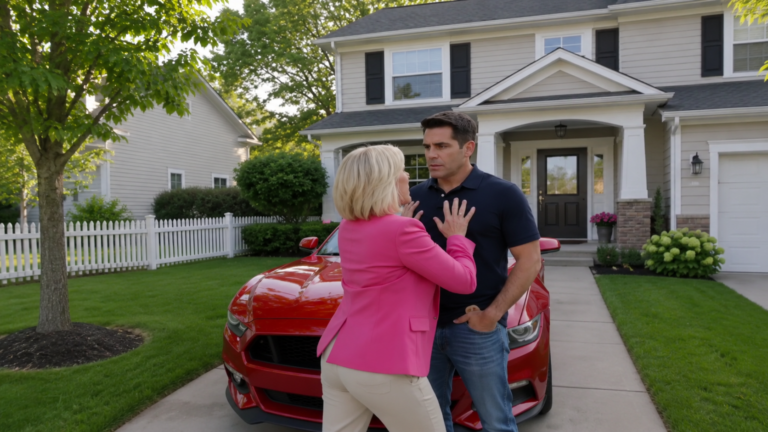
Vivian visited us at dusk carrying a folder and an expression of wounded patience.
Adrian met her at the door because I was helping Finn with a school project.
“I need to speak to your wife privately,” she said.
“Then you can ask her,” Adrian replied.
I followed him into the hallway.
Vivian remained on the doorstep.
“Your little meetings are costing people work,” she said.
“The women deserve to know how they are being paid,” I answered.
“They receive opportunities they wouldn’t otherwise have.”
“That doesn’t explain the missing money.”
Vivian opened the folder and showed me a sheet covered with signatures.
“Every participant agreed to a production arrangement,” she said.
I recognized Hawa’s name near the bottom.
Beside it was a mark made with a pen stroke that did not resemble the careful handwriting on her envelopes.
“Did you see her sign this?” I asked.
“My staff handled enrollment.”
“Then the staff can explain what the form contained.”
Vivian closed the folder sharply.
“My business employs people, Lena.”
“And those people should be paid.”
She leaned closer.
“You enjoy being the righteous person in every room.”
“I enjoy knowing my neighbors have food on their tables.”
Her gaze flicked toward the wet plaster visible behind us.
“Your water problem could get much worse if you aren’t careful,” she said.
Adrian stepped between us.
“What does that mean?”
Vivian blinked.
“Only that old pipes can fail again.”
“You know this section was struck,” he answered.
“I know you are searching for somebody to blame.”
She left before I could respond.
We called Officer Morgan and reported the exchange as accurately as we could remember it.
Later that evening, Maisie found Finn drawing the house with a waterfall emerging from one side.
“Why did you draw that?” she asked him.
“Because the lady next door said the pipes might burst again,” he answered.
I sat beside him and turned the page to a blank sheet.
“Our house is safe tonight,” I told him.
“Grown-ups are dealing with the damage.”
He picked up a blue pencil.
“Why would somebody hurt a house?”
I could not give him an answer that would make sense at eight.
Instead, I asked him to draw the people he wanted inside it.
He drew four figures around a large kitchen table, and then he drew extra chairs until the paper was crowded.