CHAPTER EIGHT: THE SECOND BREAK
The next attack came on Sunday morning while Adrian and Finn were visiting the hardware shop.
I was in the garage sorting receipts when a metallic thud sounded from the side passage.
A second thud followed, and then water began striking the concrete in hard, rapid bursts.
I ran through the gate and found Vivian standing beside the exposed supply section with a long-handled garden tool in her hands.
A fresh split opened in the new pipe, and a white stream spattered her shoes.
For a moment neither of us moved.
“Put it down,” I said.
Vivian stared at the water as though the tool had acted on its own.
“I needed you to stop,” she whispered.
“You damaged our water line again.”
“You wouldn’t listen.
”
I kept my distance and called the water utility, then Officer Morgan.
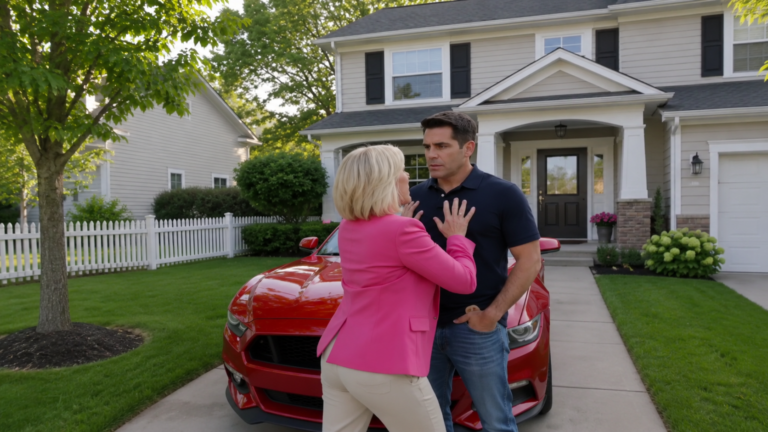
Vivian took one step toward me, and I moved backward toward the open driveway.
“Don’t make this public,” she said.
“My son is coming to town for the presentation.”
“You’ve put my children in danger of another flood.”
“I made sure nobody was near the pipe.”
“You don’t get to decide what risk my family accepts.”
Vivian dropped the tool onto the gravel.
Her eyes filled with tears, but she did not deny what she had done.
When Officer Morgan arrived, Vivian admitted striking the pipe that morning.
She insisted the first break had been an accident, although she could not explain why her broken mallet had been found nearby.
Morgan took the tool and spoke to Vivian away from the crowd gathering across the street.
I did not hear every word of that conversation, and I would not later pretend that I had.
What I did hear was Vivian asking whether the officer could delay her statement until after Tuesday.
“The timeline isn’t yours to set,” Morgan told her.
Oscar returned to isolate the damaged section.
He was angry, not merely inconvenienced.
“A repair isn’t a prop in somebody else’s argument,” he said.
We had to shut off the water again while he worked.
Maisie brought the children from two neighboring houses to help us clear wet belongings out of the garage.
Hawa arrived with towels, and Rosa carried hot food in covered dishes.
Vivian watched from her porch as people came and went through our driveway.
She looked at the women she had tried to keep away.
None of them shouted at her.
They simply continued helping us repair what she had broken.
CHAPTER NINE: THE NAME ON THE CONTRACT
Officer Morgan could not tell us whether Vivian would be formally charged that day.
She could tell us to preserve repair invoices and avoid any private bargain about the damage.
By Monday morning, the kitchen was functional again, but the garage smelled of damp cardboard.
The workers refused to cancel their meeting.
They gathered around our living room table while Celia helped them understand which questions to put to an employment solicitor.
A lawyer named Anika Wells joined by speakerphone.
“We need clear instructions from each worker,” she said.
“A common problem doesn’t mean everybody has the same employment status or the same remedy.”
Rosa asked whether they could demand their work back from the showroom.
“You may be entitled to payment and other remedies,” Anika replied.
“Ownership of the garments and the designs may depend on the agreements and the circumstances.”
Hawa exhaled.
“I want people to know who made that embroidery.”
“Then let’s establish what you created without promising a court will decide it overnight.”
At noon, Mina arrived with a printed schedule showing a rehearsal at Vivian’s showroom.
Trevor had ordered six temporary models to demonstrate stitching techniques on garments already completed by the other women.
“He’s going to make them look like the makers,” she said.
“They’re being paid to act as craftspeople.”
Maisie sat upright.
“Could we ask the models whether they know?”
Mina nodded slowly.
“One of them is my niece.”
Her niece, twenty-one-year-old Keira, had been told she would be learning a craft on camera.
Nobody had explained that the promotional script claimed she had made pieces she had never touched.
Keira agreed to meet us after rehearsal, but she asked us not to contact her employer first.
When she arrived at the hall, she looked frightened and angry.
“They gave us fake biographies,” she said.
“Mine says I’ve spent ten years studying traditional embroidery.”
Hawa looked at the young woman’s hands.
“Do you know how to thread a tambour hook?” she asked.
“No,” Keira admitted.
Hawa pushed a spare hook across the table.
“Then you shouldn’t be asked to pretend you do.”
Keira stared at it before pulling the rehearsal script from her bag.
“They want us to say Vivian taught us everything,” she said.
“If I refuse, I lose my first paid modeling job.”
“You should be paid for your time,” Rosa replied.
“But you shouldn’t have to take somebody else’s life to earn it.”