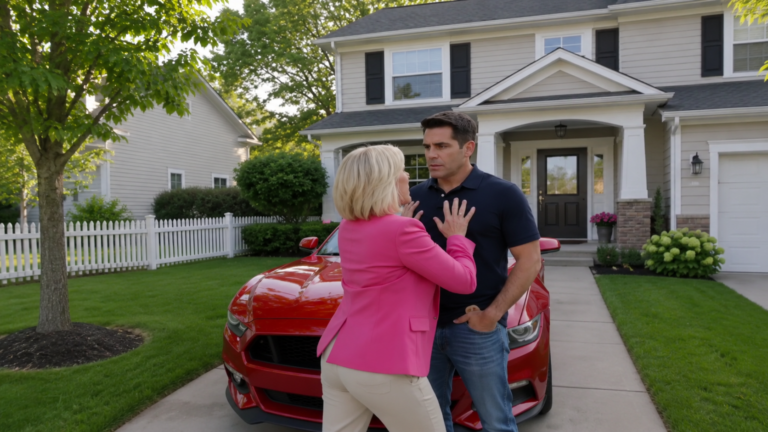
On Monday, I went to collect Finn from school and found Vivian speaking to another parent beside the crossing.
The parent looked from Vivian to me with obvious discomfort.
I heard Vivian say that the water leak had been exaggerated to attract sympathy.
She stopped when she saw me.
I wanted to challenge her in front of everybody.
Instead, I walked Finn across the pavement and waited until he was safely inside the car.
Then I returned and asked Vivian whether she wished to repeat the accusation directly to me.
“I said the situation is complicated,” she replied.
“Our plumber has inspected two deliberate breaks,” I said.
“The second happened while you were holding the tool.”
Vivian’s companion stepped backward.
“I don’t want to be involved,” she murmured.
“You already are if you’re being asked to repeat false information,
” I replied.
Vivian’s expression hardened.
“You’ve enjoyed humiliating me since the day those women came to your house.”
“I would have preferred never to know about your workers’ pay,” I answered.
“They came because they needed help, not because I went looking for you.”
Finn tapped on the car window, and I ended the conversation rather than keep him watching.
When we drove away, he asked why Mrs. Price was angry.
“She’s facing questions she doesn’t like,” I told him.
“Does that mean she can break our pipes?”
“No, it does not.”
He thought about that for two blocks.
“Then I don’t want to be famous if it makes me act like her,” he said.
“You can be famous and still be kind,” I replied.
“But fame isn’t an excuse for hurting people.
”
We drove home in silence while rain collected along the curb.
CHAPTER SEVEN: A BUYER ASKS A QUESTION
The first buyer to call me was not someone I knew.
Her name was June Ashcroft, and she had seen the neighborhood post accusing us of trying to ruin a designer.
“I’m attending the Fashion Exchange,” she said.
“I specialize in small-batch garments, and my company may place an order.”
“I can’t speak for the workers,” I replied.
“I’m not asking you to.”
She sounded exhausted.
“I’m asking whether those women can tell me how their work is being presented.”
I arranged a meeting at the community hall with Hawa and Rosa, but I told June not to bring cameras or colleagues.
When she arrived, she wore a raincoat with a button missing and carried a plain notebook.
Hawa laid one of her embroidered cuffs on the table.
“I designed the leaf pattern,” she said.
“Vivian’s catalog says she designed it.”
June compared the sample with a picture on her phone.
“The pattern isn’t the only issue,” she replied.
“The catalog claims a supervised paid apprenticeship.”
Rosa described finishing dresses at home between midnight and dawn.
“Who supervised you?” June asked.
“Nobody,” Rosa said.
“If there was a mistake, they refused to pay for the piece.”
June set down her pen.
“Our purchasing team was offered a tour where the makers would demonstrate the work.”
“Which makers?” Hawa asked.
June hesitated.
“That’s what I came to find out.”
She showed us a schedule listing a demonstration by six studio artisans.
None of the names matched those in the room.
The women studied the page until Mina broke the silence.
“Those are the women who model the finished clothes,” she said.
“They aren’t the ones sewing them.”
June asked for permission to note that discrepancy, and each woman gave her an answer separately.
No one was pressured to agree.
After June left, Hawa folded the sample cuff into her bag.
“She might not believe us,” she said.
“She might believe you and still buy the clothes,” Rosa answered.
Neither woman sounded reassured.
That afternoon, Vivian posted a polished statement about honoring invisible labor.
It included a photograph of sewing hands and a promise that a portion of sales would support local families.
I recognized those hands immediately.
They belonged to Hawa, and the photograph had been taken without asking her during a fitting.