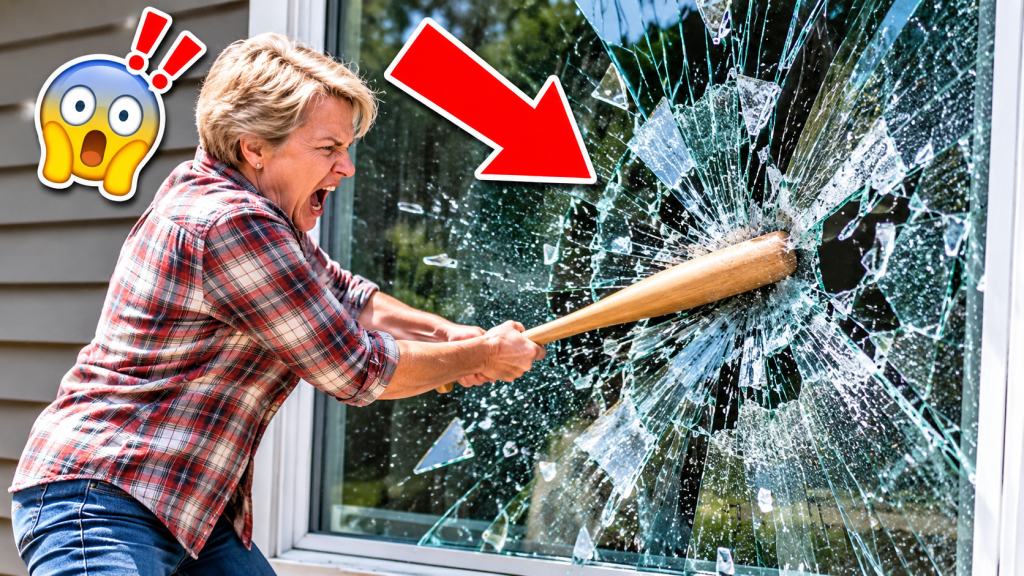
The first crack sounded like a rifle shot in my kitchen.
I was standing at the sink with a coffee mug in my hand when the glass door behind me shuddered inside its frame.
A second blow followed before I could turn around.
The lower corner of the patio door burst into a white spiderweb of fractures, and a heavy steel garden ornament bounced across the deck.
My neighbor, Lorraine Voss, stood on the other side of the ruined glass wearing a yellow raincoat and the satisfied expression of somebody who had just won an argument.
She raised her phone and pointed it at me through the shattered panel.
“You had thirty days to comply, Nathan,” she announced.
I put my coffee down carefully because my hands had started shaking.
“You just broke my door,” I said.
“I enforced a recorded restriction,” she answered.
She held up a sheet of paper inside a plastic sleeve.
Across the top, in oversized capital letters, someone had typed the words EXTERIOR VISIBILITY AND ACCESS CLAUSE.
I had seen that paper before, although it had never appeared in the documents I signed when I bought the house.
According to Lorraine, the clause gave the neighborhood’s original homeowners the right to remove any obstruction that interfered with the historical view from their adjoining property.
The obstruction she meant was a set of blue curtains hanging inside my own living room.
The curtains belonged to my late sister.
She had sewn them herself during the final winter of her life, when her hands were still steady enough to guide fabric through a machine.
Lorraine had been demanding that I take them down for six weeks.
Now she had apparently decided that breaking the door was a legitimate way to reach them.
“The police are coming,” I told her.
She laughed and adjusted the hood of her raincoat.
“Good, because I have the paperwork.”
Then she looked past me toward the narrow hallway leading to the back bedroom.
Her expression changed for half a second.
It was not the look of a woman concerned about curtains.
It was the look of someone checking whether a particular door was open.
I would remember that glance long after the glass had been swept away.
At the time, I still believed this was a dispute about an unreasonable neighborhood rule.
I did not know that Lorraine had spent nearly a year trying to get inside my house, or that the clause she kept waving had been created for a reason nobody on our street understood.











