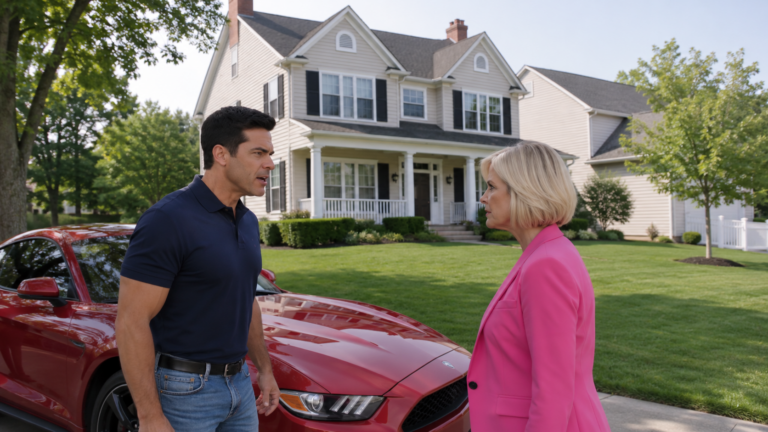
Before Kira arrived at my porch, I met a young man who introduced himself as Devon.
He was carrying a grocery bag and searching for a house number that had been painted over on a mailbox post.
“Is this number twelve?” he asked.
“It’s number ten,” I replied.
“Twelve is two doors down.”
He looked relieved.
“I moved here yesterday.”
“Welcome.”
He glanced at the red writing on my door.
“Did somebody do that because you moved here?”
“I don’t know why they did it.”
He nodded as though that was an answer he had expected.
I asked whether he needed help finding the house.
He said he could manage and continued along the sidewalk.
Ten minutes later, he returned without the grocery bag.
“Can I ask you something?” he said.
“Of course.”
“Do people here get to choose who visits them?”
I considered the question.
“That depends on their housing arrangement, but people should be told what rules apply and why.”
“They said my brother couldn’t come over.”
“Who said that?”
“The house manager.”
“Did they explain the rule?”
“They said it was a neighborhood preference.”
I gave him the number for the independent residents’ advocate and suggested he ask for the written visitor policy.
He looked at the paper without taking it.
“Will they know I called?”
“You can ask how they protect confidentiality before sharing details.”
He took the number and folded it into his pocket.
“My brother drove me here,” he said.
“He wants to know I’m okay.”
“That sounds reasonable.”
Devon looked at the door again.
“Maybe everybody here is scared of somebody.”
He walked away before I could answer.
That night, I wondered whether he had managed to speak with his brother.
I did not know his last name, and I did not try to find it through my work.
Three days later, he passed my house with another young man who looked enough like him to be family.
They were laughing about a basketball game.
Devon raised one hand when he saw me.
I waved back and kept watering the garden.
CHAPTER FOUR — THE FIRST VISITOR
The first young person to knock on my door was named Kira Moss.
She arrived after dark wearing a grocery store uniform and carrying a cracked bicycle helmet.
She was nineteen and spoke as though she expected every sentence to be interrupted.
“Mina said you might listen,” she told me.
I invited her onto the porch, where the replacement door had not yet been painted.
Kira refused to come inside.
“I only have ten minutes,” she said.
“My house checks where we are.”
“Who checks?”
“The residence manager.”
“What happens if you’re late?”
She shrugged.
“They say we lose weekend passes.”
I asked what she wanted to tell me.
She pointed across the street.
“Mrs. Hollen says you moved here to shut down the houses.”
“I didn’t.”
“She says you’re going to make everybody homeless.”
“Why would she say that?”
“Because you won’t join her group.”
Kira looked down at her helmet.
“She asked me to carry a bucket over here last night.”
My stomach tightened.
“What was in it?”
“Paint.”
“Did you bring it?”
“I said no.”
“What did she do?”
“She told me my workshop access could disappear.”
Kira rubbed the cracked edge of the helmet with her thumb.
“I need that workshop for my welding certificate.”
“Did she ask anybody else?”
“She asked Theo.”
I knew enough not to press a frightened young woman into making a statement she could not safely support.
Instead, I asked whether she had a place to sleep tonight and whether she wanted a number for independent assistance.
She said she had a bed but was afraid of losing it.
I wrote down the independent residents’ advocate’s public contact number and gave it to her.
“You can call without telling me anything else,” I said.
“Will they tell Northbridge?”
“You can ask about confidentiality before sharing your name.”
Kira took the paper.
“You don’t talk like the other neighbors.”
“I’m new,” I said.
For the first time, she smiled.
“That’s what they hate.”
She walked away with her helmet under one arm.
A minute later, a porch light switched on at Patricia’s house.