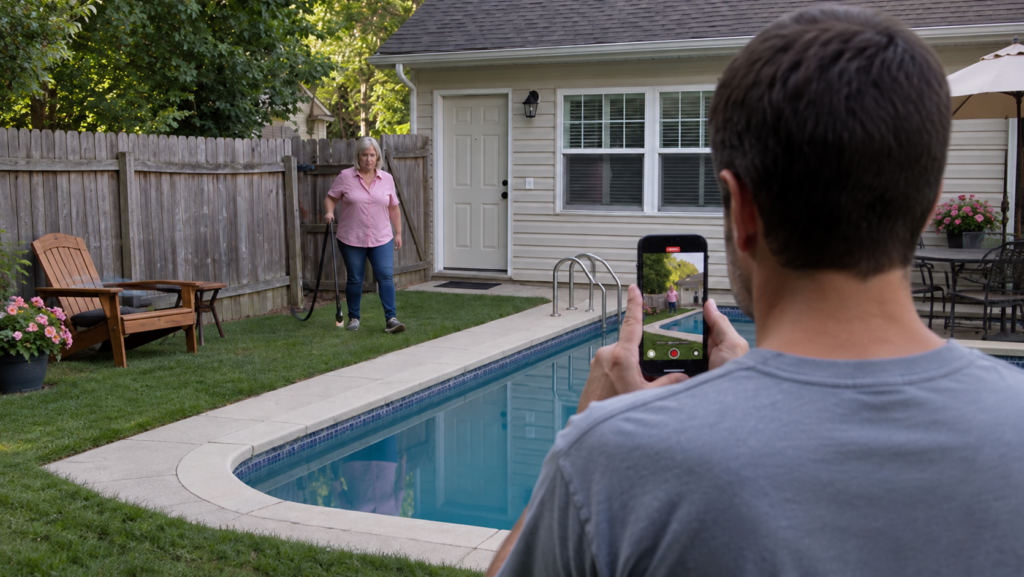
The black cord dragged across the grass like a line drawn between two different stories.
Mara Voss stood in the open kitchen doorway with a grocery bag still hooked over her wrist.
Her neighbor, sixty-three-year-old June Talbot, was kneeling beside Mara’s swimming pool.
June held one end of the cord inches above the water.
At the far end of the yard, June’s nephew Owen Pike recorded everything with his phone.
Mara put the groceries down without looking away from June.
“Move away from the pool,” Mara said.
June lifted her head.
“You should have answered your door yesterday.”
“That doesn’t give you permission to come into my yard.”
Owen stepped sideways to keep all three people in the frame.
“I saw everything,” he announced.
Mara noticed that he had not asked June to stop.
She also noticed that the cord ended in a thick rubber sleeve rather than an ordinary electrical plug.
“Is that connected to power?” Mara asked.
June’s mouth tightened.
“You think I’m stupid enough to bring a live wire into water?”
“I don’t know what you’re doing.”
“That’s exactly the problem,” June replied.
Owen moved closer.
“Can you repeat what you said about the wire?”
Mara looked directly at his phone.
“I said that I don’t know what you’re doing.”
June stood up too quickly and lost her balance.
Her left shoe slid against the wet coping.
Mara reached for her instinctively.
June caught Mara’s sleeve, then deliberately let her knees buckle.
She landed on the lawn, well clear of the pool.
Owen rushed forward with his phone still raised.
“You pushed her,
” he shouted.
Mara stared at him.
“I caught her.”
June remained on the grass with one hand against her shoulder.
“My arm,” she whispered.
Mara backed away and called emergency services.
She told the dispatcher that an older woman had entered her yard with an unidentified cord and fallen beside the pool.
She did not accuse June of pretending.
She did not touch the cord.
She did not move June.
Owen kept filming until the ambulance arrived.
Then he stopped the recording and slipped his phone into his pocket.
CHAPTER TWO: THE FIRST VERSION
By sunset, the video had reached half the neighborhood.
Its opening frame showed Mara reaching toward June.
Its next frame showed June collapsing.
The first thirty seconds, including the cord and Mara’s questions, were missing.
The caption called Mara a violent homeowner who had assaulted an elderly woman trying to warn her about a dangerous swimming pool.
Mara watched it once on her sister’s phone.
Her sister, Lena, sat beside her at the kitchen table.
“You need a lawyer,” Lena said.
“I need to understand why June was there.”
“Both things can be true.”
Mara turned her own phone face down.
She worked as a freelance caption editor, and she knew how much a cut could change the meaning of a sentence.
But knowing that did not make the comments less frightening.
People who had never met her were calling her dangerous.
A local parenting group had already warned families to avoid her house.
June’s nephew had posted a second clip of an ambulance leaving the street.
In that clip, Owen claimed June had been trying to prevent a tragedy.
He did not explain what tragedy she expected.
Mara called the nonemergency police number and asked how to document the trespass and the disputed video.
An officer took her statement and told her not to confront June.
When Mara hung up, Lena pointed toward the back window.
A small white card had been pushed beneath the patio gate.
It carried three words in blue ink.
ASK ABOUT ELLIOT.
Mara had never heard the name.











