The brick came through the patio window at four seventeen on a Thursday afternoon, when the sun still made a bright square on the living room rug.
Mara Ellison had been lying on her sofa with a notebook balanced on her knees, trying to find a decent ending for a children’s story she had promised to read at the library. She heard two soft footsteps outside, a scrape against the concrete, and then the violent crash. A brick bounced once on the hardwood floor. Glass traveled across the room in glittering arcs.
Mara threw her arms over her face. A small piece struck her sleeve. She stayed crouched for several seconds, listening for another blow.
“What was that?” she said, although the answer sat among the broken glass.
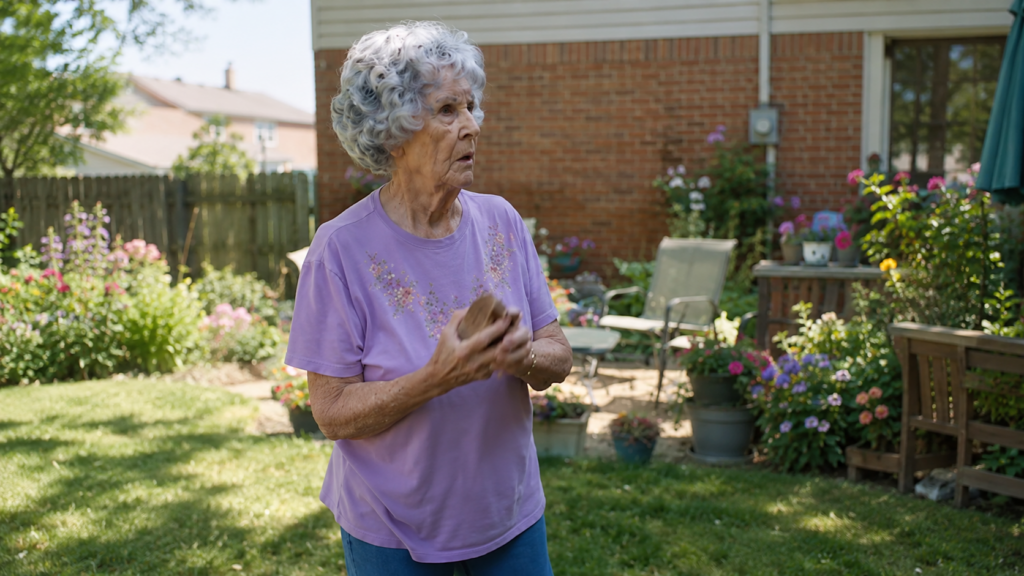
Through the jagged opening she saw an elderly woman in a pale yellow cardigan walking briskly toward the side fence. The woman kept her shoulders stiff and her head lowered. Mara knew her as Willa Fenwick, from two houses down, a retired school bus driver who rarely spoke to anyone without first checking whether they had parked across the sidewalk.
Mara started toward the patio, then stopped. Her phone was in her hand already. The gallery was open because she had been choosing pictures for the library reading. She swiped past a photograph of a blue paper kite, then another of a cardboard castle. The third showed the back of her house taken the previous evening.
She stared.
There was a small red wagon beside the garden shed in the photograph. Mara had never owned a red wagon. In the next image the wagon was gone, but a chalk arrow pointed toward the narrow gate. In the next, a young boy with a shaved head stood half behind the fence, looking directly at the camera. He wore a lime-green raincoat despite the clear evening.
Mara hadn’t taken those photographs. They had appeared in the shared album she used with the library’s volunteer photography group. Someone had uploaded them under her name.
A new photograph arrived as she watched. It showed Willa Fenwick on Mara’s patio at four twelve that afternoon, five minutes before the brick. Willa was looking toward the upstairs window, holding the brick at her side. Behind her, in the reflection of the intact glass, stood a man with a narrow black case. His face was outside the camera’s direct view.
Mara glanced at the shattered pane. The reflection was gone now.
Her security app chimed. The patio camera had recorded the impact. Mara opened the video, scrubbed back thirty seconds, and saw Willa cross the lawn. Nothing surprising yet. But when she slowed the image, Willa paused before throwing, looked deliberately toward the camera, and formed three words with her lips.